E-learning strategy -
that's what matters
02-01-25 | 6 minutes reading time
that's what matters
02-01-25 | 6 minutes reading time

Julia Kammermeier
Customer success
The hybrid working world and new technologies such as AI are fundamentally changing the way we learn. Modern companies therefore rely on sophisticated blended learning concepts that enable flexible and personalized learning. The digitalization of learning content is not just an HR or IT initiative, but a strategic transformation that needs to be well planned. Only then will the efforts be crowned with lasting success.
Although the start can be pragmatic, it should always be based on a clear concept. In this article, we present the five essential building blocks of a successful e-learning strategy and show how you can implement them in a timely manner.
Content strategy: make or buy?
A key question at the start of your e-learning project is: Where does the content come from? The answer to this is now more diverse than ever, because in addition to the decision between production in-house and external production by a service provider, artificial intelligence also opens up new possibilities. When developing a content strategy, it is important to make clever use of all options and find the optimal combination depending on the learning project, internal resources and expertise.
In the make or buy decision, there are now four options that can be flexibly combined:
The first step is therefore to define when to choose which of the four options. Various questions play a role here, such as: Does standard content match the company's aspirations and culture? Are sufficient resources, skills and capacities available to create the content yourself? Is the project under time pressure? Is there suitable content on the market? Where does the use of AI-supported content production make sense? Which AI tools can support the process? Our make-or-buy decision tree addresses these and other important questions and helps you to make a make-or-buy decision. You can download the decision tree as a PDF here:
When it comes to in-house production, modern companies are increasingly relying on AI-supported authoring tools that also enable specialist departments to create content independently (user-generated content).
These tools provide support with:
Nevertheless, humans remain the decisive factor: AI is a powerful assistant, but does not fully replace the didactic expertise and specialist knowledge of content creators. Successful in-house production still requires a qualified project team and clearly defined processes - only supported by intelligent tools that make the work more efficient.
Didactic learning concepts: Personalized and adaptive for learning success
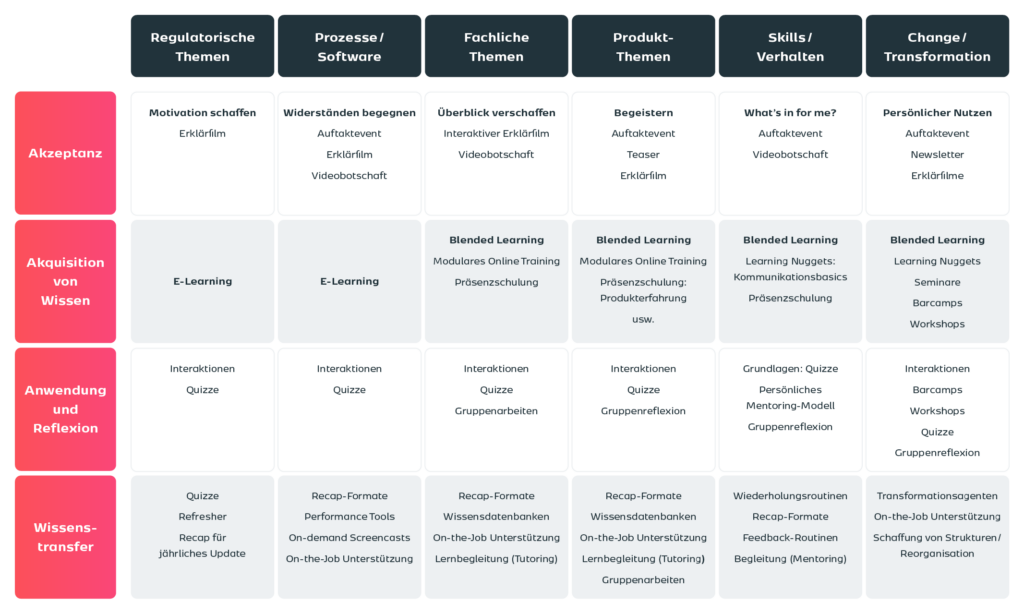
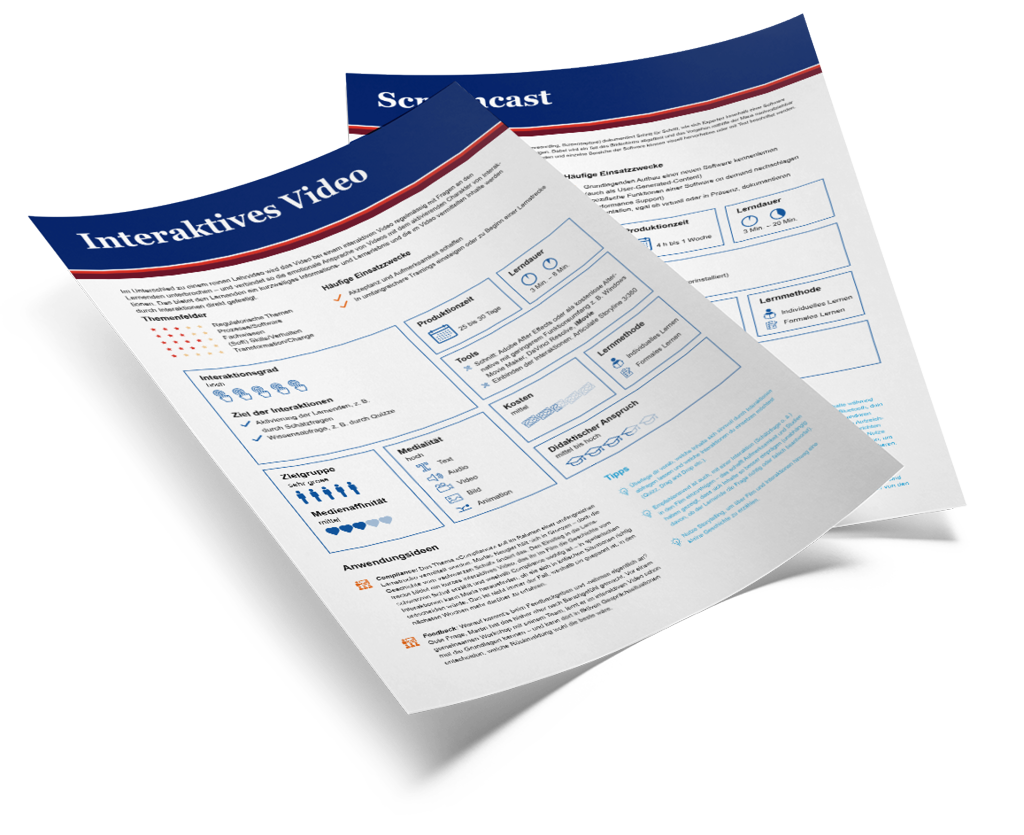
The second important building block in the development of the e-learning strategy is the didactic concept. For digital learning to be effective and the content to be sustainably anchored in learners' minds, it is essential to choose a learning format that makes sense from a didactic perspective. As a first step, it is helpful to compare the different learning formats and evaluate them for your own use case. We have developed learning format profiles for this purpose, in which we present the advantages, disadvantages and purposes of the individual classic formats - such as interactive explanatory films, WBTs, webinars or podcasts. Would you like to work with the profiles yourself?
Here you can request the 16 fact sheets.
Modern technologies go even further and now enable adaptive learning paths and personalized learning experiences. From the outset, however, it is crucial to have a didactic design that makes targeted use of these possibilities and at the same time takes proven learning principles into account.
The so-called model of knowledge acquisition also helps in the selection of suitable learning formats
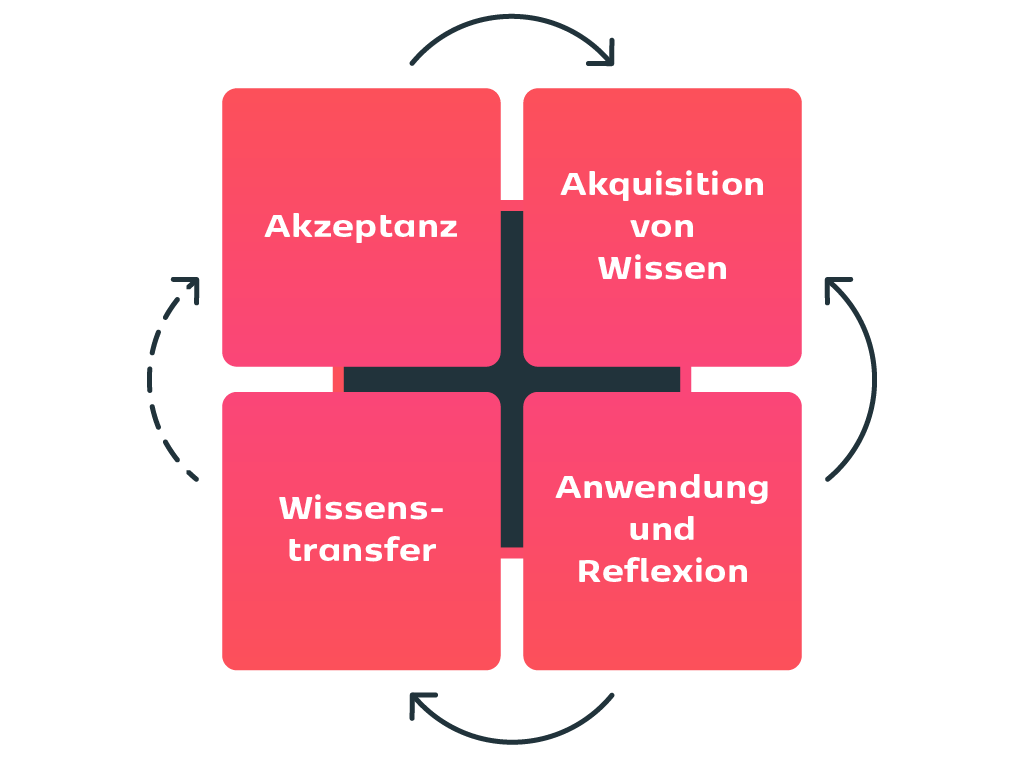
This model begins with the phase of acceptance creation, through the acquisition of knowledge, application and reflection to knowledge transfer. In the next step, these phases are supplemented by different subject areas, so that a matrix results from the model of knowledge acquisition and the subject areas. This subject-module matrix serves as a basic scheme for selecting didactically meaningful learning formats.
E-learning distribution: Modern learning platforms for contemporary learning experiences
The best content strategy is of little use if the learning content does not optimally reach its target groups. Even if modern learning platforms - such as learning experience platforms (LXP), skills management systems and AI-supported learning environments - go far beyond the functions of classic learning management systems (LMS), the latter are still a solid basis for the targeted distribution of learning content.
Anyone looking for an LMS will soon come to a sobering realization: The choice on the market is gigantic. So how do you find the right system? Here, too, you should take a strategic approach and ask yourself a few basic questions in advance: How will the learning content be structured? Which reports are required? Should the LMS be used on premise (operation on your own servers) or via the cloud? Which license model makes sense? These are just a few of the questions that should be considered when selecting a suitable LMS. In the article you can find out more about this topic.
Acceptance management: learning starts with motivation
And last but not least, it is important to make e-learning appealing to the target groups. Only with good acceptance management will it be possible to inspire learners and ultimately achieve the goals of the educational project. Acceptance management depends on three key points: The organization, the communication and the learning content itself.
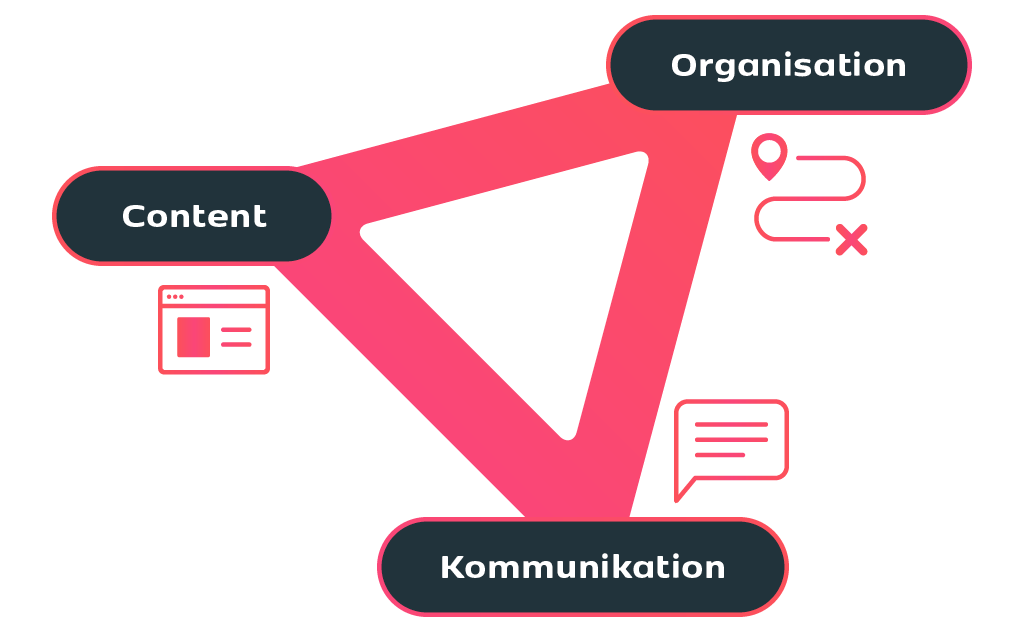
We have already discussed the learning content and its didactically sensible preparation as well as the organization. However, the third aspect, the communication of the planned measures, should not be neglected. In order to create acceptance for digital learning, it is important to market it accordingly - in other words, to promote the learning content, in particular to explain its benefits and offer learners a feedback channel.
Modern technologies support us in this: personalized notifications provide targeted reminders of relevant learning content, AI-supported recommendations show suitable next learning steps and micro-credentials make learning successes directly visible. This turns "learning must" into "learning wants" - because the personal added value is recognizable and learning fits naturally into everyday working life. You can read more helpful tips on how to achieve this in our article
Success factor learning culture
All of these aspects form the breeding ground for digital learning. However, digital learning can only really bear fruit if there is a appropriate learning culture in the company. This means that e-learning must be firmly anchored in the corporate strategy. Managers, works councils, regional and divisional managers should be involved at an early stage in order to obtain their commitment and act as role models for lifelong learning.
In addition, employees should have sufficient learning time available within their working hours - whether through fixed learning times or flexibly integrated into the working day. This contributes in particular to acceptance and is becoming increasingly important in the hybrid working world. Employees should be actively involved and have low-threshold opportunities to share their knowledge with others in the company - for example through internal learning communities or as content creators for learning units.
And finally, further training should also be anchored in the company's goal system, for example in the form of team and individual goals. This is because the systematic development of future skills is becoming increasingly important in order to make employees fit for digital change.
These five building blocks form the basic framework for a sustainable e-learning strategy. Read our case study with Emmi to find out what the development of an e-learning strategy can look like in practice. Emmi's goal was to be able to produce learning content in-house in the future - to achieve this, the food company turned to youknow's strategy consulting. In the case study, you can find out how we approached the project and how Emmi now produces content efficiently and independently with clearly defined processes.

Julia Kammermeier
You have the goals, we have the solutions – together we will find the best one for you.