Acceptance in e-learning:
Your topic simply to the point
28-01-20 | 7 minutes reading time
Your topic simply to the point
28-01-20 | 7 minutes reading time

Carsten Albus
Software development
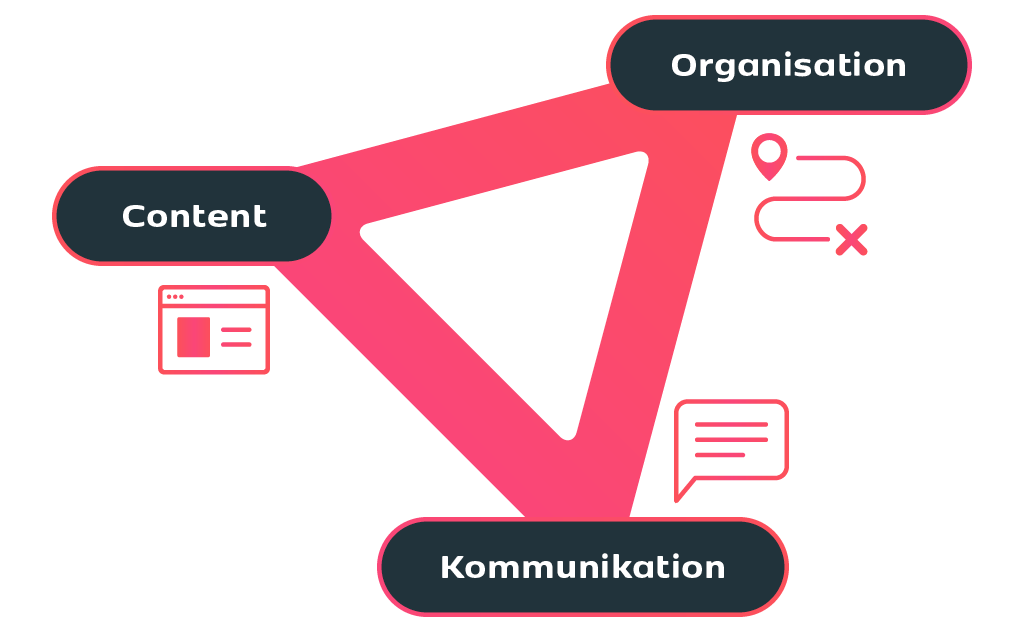
The path to learning success starts with motivation. Only when "having to learn" becomes "wanting to learn" can learning really be successful. How can you get your employees interested in corporate learning and increase the acceptance of e-learning in your company? Various factors play a role here, which we illustrate in the so-called acceptance triangle. The triangle consists of the corners of content, communication and organization. In this article, you can find out what it is all about and what needs to be considered for each of these factors.
Content and its preparation play a decisive role in learner acceptance. We give you a few tips on how to make learners want corporate learning with your content.
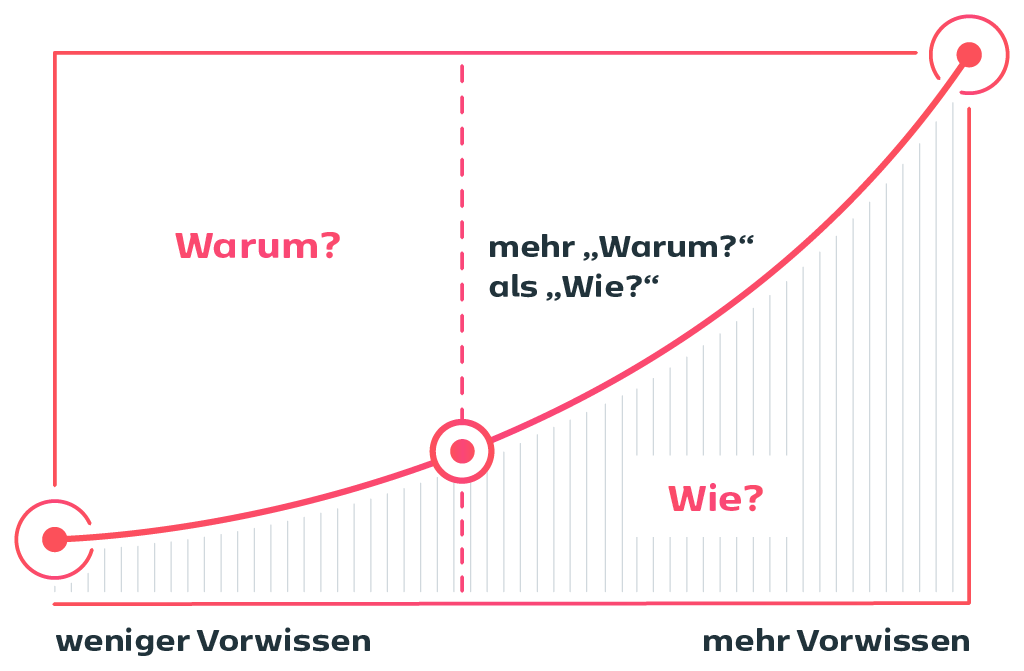
Before you start preparing and designing content, you should determine the knowledge level of your target group. We are often trapped in the curse of knowledge. This means that we are very familiar with our topic and assume that the target group has the same prior knowledge - but this is usually not the case. Therefore, take the target group's perspective and develop the learning content according to their prior knowledge. Often, the target group does not even know why they should be interested in the learning content - in this case, the "why" must first be explained before moving on to the "how". We illustrate this topic in the "Why-How-Diagram ".
Basically, the less prior knowledge the target group has, the more time should be devoted to the "Why?". Only when you are dealing with experts is it worth discussing the "How?" in detail.
Whether your training concept starts with an explainer video, learning content is taught via face-to-face training in combination with learning nuggets or gamification elements such as a quiz app play a role - the right mix is crucial for your learning project to be a success. The combination of different learning methods and media ensures variety, a high level of involvement and thus sustainable knowledge acquisition.
Depending on your learning objectives, the use of user-generated content may also be an option. This involves colleagues talking to colleagues, which boosts learner motivation. For example, videos created by colleagues for other colleagues appear authentic, create relevance and thus increase acceptance among learners.
But how do you find the optimal mix of methods? In our blog article on the topic you can find out what is important when selecting and combining learning methods.
It's no coincidence that microlearning is one of the e-learning trends par excellence. After all, who wants to study for several hours at a time alongside their daily work routine these days? Probably very few. That's why the trend is towards learning in small units that can be easily integrated into the working day.
In the following video, you can find out about the advantages of microlearning.
We remember stories much better than pure facts. There are various studies that always come to the same conclusion: if you communicate bare facts, people only remember an average of 5% of the specific content after 10 minutes. If you wrap the facts in stories, they remember 22 times more (Jennifer Aaker, Professor of Marketing at the Stanford Graduate School of Business). One of the reasons for this is that stories arouse emotions.
Storytelling can thus help to motivate employees to learn and increase e-learning acceptance.
We have summarized the most important Tips for good storytelling for you in a blog article. Would you like to learn more and become a storyteller yourself? Then our storytelling workshop might be the right thing for you.
And finally, the visual presentation of the content also plays an important role in creating acceptance in e-learning. The learning interface should be clear and fit in with the company. Interfaces and courses should also be consistent across all topics and fit in with the overall image. To ensure this - even with user-generated content - it is advisable to develop a style guide for online training and make it available to everyone who creates learning content.
For our client ZHAW, we have developed such a style guide and a web-based training course that introduces the target groups to this style guide. This video gives you an insight into the project.
As we mentioned at the beginning of the article: Learning success starts with motivation. To motivate employees, it is essential to create relevance for them. When communicating, focus on the benefits for the employee in order to convey why the content is relevant to them. The communication itself should be motivating and appealing - at the same time, the handling of personal data should always be communicated transparently and free of misunderstandings.
Build a brand for your digital learning world and ensure that the topic is constantly present for your employees. You can do this by communicating e-learning topics not just selectively, but permanently, focusing on different topics depending on current campaigns and training roll-outs. In this way, you can anchor e-learning in the company and in the minds of employees in the long term.
You can also use various communication channels to reach learners exactly where they are and get information. All online media such as an intranet, the website, chats or social networks are suitable channels, as are offline channels such as meetings, events or giveaways.
Also provide a feedback channel in communication to give learners the opportunity to provide feedback. There should always be a contact person for topics relating to e-learning content who learners can turn to if they have technical problems, questions about the system or feedback on the content, for example. This increases learner acceptance and at the same time helps you to identify needs and optimize your e-learning content and solutions.
And last but not least, a clear and public commitment from management is essential for the acceptance of e-learning among employees, for example by means of a video statement or a kick-off event.
In addition to learning content and communication, the organization plays a central role in the acceptance of e-learning by employees. On the one hand, e-learning must be anchored in the corporate strategy. Managers, works councils, regional and divisional managers should be involved at an early stage in order to obtain their commitment.
In addition, e-learning must be part of a learning culture in which trust is lived and in which there is freedom for orientation and knowledge acquisition. Employees should be given sufficient learning time within their working hours. They should be actively involved, for example to jointly identify needs and design attractive learning content. Voluntary online training in particular should be accompanied by a learning guide who navigates learners through the content and helps them to find the content that is relevant to them.
Further training should also be anchored in the company's target system: For example, in the form of team and individual goals.
And last but not least, the technology must work and be geared towards the weakest devices and connection qualities. This requires a hardware strategy that defines, among other things, which devices should or may be used for learning. One possible strategy is the "Bring Your Own Device" (BYOD) strategy, in which - as the name suggests - learners learn on their own devices. Here, it must be ensured that the technology is operational and works on all devices used by the learners. This should not be underestimated under any circumstances, as functioning technology is essential for acceptance and therefore for learning success.

Carsten Albus
You have the goals, we have the solutions – together we will find the best one for you.