How do I explain complex topics in simple terms?
5 proven methods
03-07-18 | 5 minutes reading time
5 proven methods
03-07-18 | 5 minutes reading time

Friedl Wynants
Founder & Managing Director
Explain complex topics effectively using five proven methods: Overcome the “curse of knowledge,” shift your perspective to that of your target audience, reduce your message down to its core elements, use simple language, and employ storytelling techniques.
"Any intelligent fool can make things bigger and more complex. It takes a bit of ingenuity – and a lot of courage – to move in the opposite direction. "
This quote from Albert Einstein reflects what we do every day with our work: Reduce things to the essentials and make them understandable for different target groups. Here are five tips to help you explain complicated things simply and convincingly.
You would think that technically competent people in particular are best at explaining things. However, the exact opposite is often the case. We refer to this phenomenon as the "curse of knowledge": It is very difficult for a well-informed person to put themselves in the shoes of someone who does not have the same level of knowledge. As a result, experts often explain things at a level that is incomprehensible to the layperson - and don't even realize it. In this respect, the first step towards simple explanations is to realize that in many cases your own level of knowledge does not correspond to that of the other person. You can find out how to do this in the following video.
This is how you overcome the curse of knowledge:
Why this works: Neuroscientifically speaking, we cannot "unknow" what we have once learned. Our brain makes automatic connections that laypeople do not have. Conscious self-reflection breaks this mental autopilot and forces us to change our perspective.
As we learned in the video, it is necessary to deal with the pre-knowledge level of the target group and take their perspective in order to escape the "curse of knowledge". We are always explaining innovative products; recently an app that the target group can use to control their entire house - from the washing machine to the blinds to the heating. Our client never tired of listing the many possible applications and technical refinements of his app and wondered why his communication was still not having the desired effect. In the first step, we analyzed the target group: What do ordinary consumers and the little girl in the house know about the "smart home"? The results confirmed our assumption: the target group had heard that they could control the heating with their cell phone. What they didn't know was what added value this could have for them.
And this is where target groups often differ from people who have a lot of prior knowledge: While experts want to talk about every single leaf on the tree, the target group doesn't even know why they should be interested in the forest. The less prior knowledge a target group has, the more space should therefore be given to answering the question "Why should I be interested in this?" within an explanation in order to pick up the target group. As a result, the following applies to detailed explanations - usually the "How?": the shorter, the better! For an expert target group, on the other hand, the "how" can be the focus of the explanation and the "why" can be kept short.
So: The less prior knowledge the target group has, the more time should be devoted to the "Why? Only when you are dealing with experts is it worth talking in detail about the "How?
        Target group
        Why share
        How share
        Example


        Laymen
        70%
        30%
        "Why do I need a smart home?"


        Advanced
        50%
        50%
        Balanced explanation


        Experts
        30%
        70%
Focus on technical details| Target group | Share of "why" | Share of "how" | Example |
|---|---|---|---|
| Laymen | 70% | 30% | "Why do I need a smart home?" |
| Advanced | 50% | 50% | Balanced explanation |
| Experts | 30% | 70% | Focus on technical details |
Why vs. how: finding the right balance
And this is where target groups often differ from people who have a lot of prior knowledge: While experts want to talk about every single leaf on the tree, the target group doesn't even know why they should be interested in the forest. The less prior knowledge a target group has, the more space should therefore be given to answering the question "Why should I be interested in this?" within an explanation in order to pick up the target group. As a result, the following applies to detailed explanations - usually the "How?": the shorter, the better! For an expert target group, on the other hand, the "how" can be the focus of the explanation and the "why" can be kept short.
So: The less prior knowledge the target group has, the more time should be devoted to the "Why? Only when you are dealing with experts is it worth talking in detail about the "How?
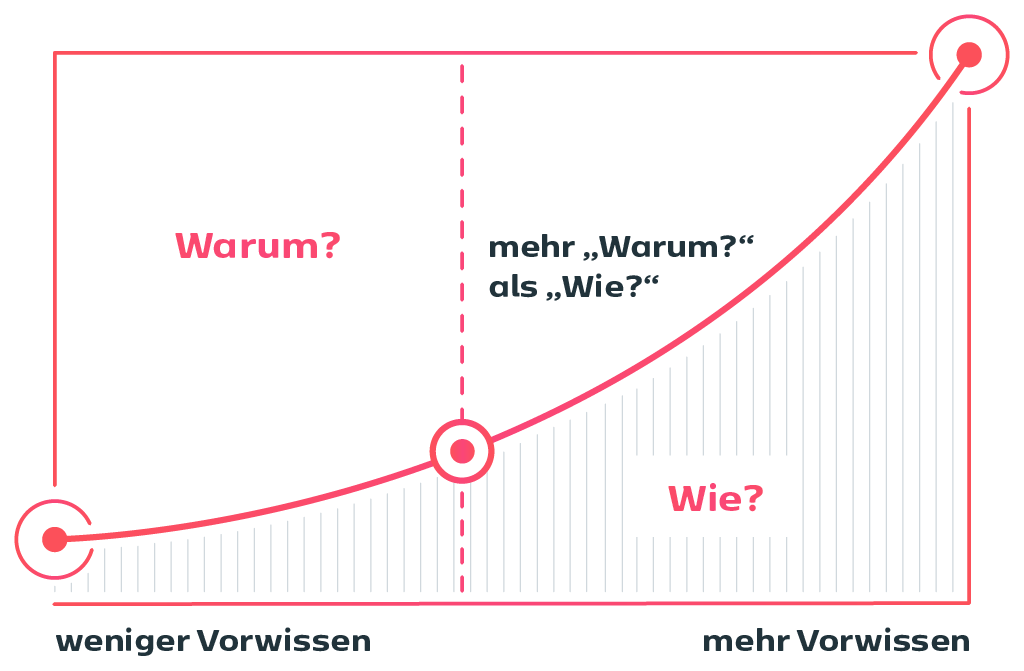
Nevertheless, the "why" should be addressed to an adequate extent in every explanation, regardless of the addressee - because this is where explanations differ from instructions or recipes: the appeal of a good explanation lies in always answering the question of "why " and thus giving facts a meaning. In this way, it is also possible to create context and make the facts connectable.
Creating connections: Building on existing knowledge
And something else is important for connectivity: if you wanted to explain to a child what a cubist is, you would first have to take a step back and explain to them what a painter is. In this way, the new fact is linked to what is already known and is processed more quickly by the brain and stored better. This is basically true: our brain copes better with new knowledge if it is linked to what we already know.
Why this works: The brain constantly filters information according to relevance. Without a clear benefit ("Why is this important for me?"), it switches to "unimportant" and stops listening. The "why" question activates the reward center and makes us attentive to the following details.
We now know the level of knowledge of our target group and are aware that it differs from ours. The next keyword is now "core messages ". Use the why and how diagram from tip 2 to find out what the really essential messages are for your target group and get rid of anything you don't absolutely need. The rule here is: less is more!
Why this works: Our working memory can only process 7±2 units of information at a time (Miller's rule). When there is an overload of information, the brain switches to "survival mode" and forgets everything. Reduction to 3 key points makes optimum use of this mental capacity.
In addition to changing perspectives and weighting, another important vehicle for understandability is language. However, the affinity for convoluted sentences, technical terms and nominal style is widespread. There are simple tips that can help you formulate comprehensibly:
Short sentences: Short (maximum 15-20 words), less complex sentence structures make it easier for the recipient to remember content, as the working memory must retain the beginning of the sentence until the end in order to understand its meaning.
Active wording instead of passive: Active wording is better than passive because it makes it clear who is acting and, as the name suggests, activates the reader. An example: “We develop” instead of “is being developed.”
Avoid technical language: Avoid technical terms in your explanations if they are not familiar to your target group.
Delete adjectives: Do not use too many adjectives. The rule of thumb here is to delete two out of three adjectives and assume that your audience is mature enough to decide for themselves what they think of something.
Once we have chosen and structured our content, we need to package it in a way that the recipient will accept it. Storytelling is an effective tool for communicating content in a sustainable way. You should certainly mention facts, because they give your story substance. But only stories make the facts tangible. And: stories stay in the mind. There are various studies that always come to the same conclusion, such as this one: If you communicate bare facts, 5% of people still remember specific content after 10 minutes. If you wrap these facts in a story, 75% - that's 15 times more!
You can find out why stories have such an impact and how you can use storytelling in our article on the topic storytelling.
Practical tips on how to explain topics simply and use "storytelling" for your company.
Download our free guide and find out which tools you can use to explain topics simply and harness the power of storytelling.
Change of perspective, weighting, language - if you pay attention to these in your explanations, simple explanations are much easier and pave the way for the recipient to the most valuable thing that societies, companies and individuals have at their disposal: Knowledge. If you enrich your explanations with stories, you will ensure that your target group remembers your content in the long term. Because those who communicate with stories communicate more sustainably.
You have the goals, we have the solutions – together we will find the best one for you.
The change of perspective (Explanation tip 2) is the foundation. Without understanding what your target group already knows and why they should be interested, all other techniques will come to nothing. Always start here.
Quite simply: ask actively. "Is that clear enough?" - if you get more than 2-3 questions, your explanation is too complex.
Ask simple test questions before the explanation: "Have you ever heard of XY?" or "What is the first thing that comes to mind when I say ABC?" For presentations, you can conduct a short survey beforehand or ask the audience directly.
Use the "onion principle": start with the basic layer for everyone, then peel back deeper for advanced users. Say: "For those who want to go deeper..." That way you won't lose anyone and won't bore the experts.
Yes, but with a system: introduce new terms individually and explain them immediately. A maximum of 2-3 new technical terms per conversation. Rule of thumb: If you have to repeat a technical term 5 times, it is one of your 2-3 most important terms.
The opposite is the case: those who can explain complex things simply are considered particularly competent. Einstein, Feynman, Jobs - all famous for simple explanations of complex ideas. It is only too simple if you leave out important nuances that would be relevant for decisions.
Especially there! Technical content already places a heavy burden on the working memory. In addition, short sentences create mental "breathing spaces" that give the listener time to process the information.
**Example
❌ "The API interface enables external applications to access our database structure via HTTP requests."
✅ "The API is like a front door. External programs can knock. If they are trustworthy, they get access to our data."
Yes, even particularly important. When it comes to emotional topics, rational thinking sometimes switches off. Simple language and a clear structure help people to understand despite their emotions. But avoid oversimplification - it comes across as patronizing.
Three proven sources:
Make a note of good stories when you come across them.
Use the "imagine" technique: "Imagine you want to go to work tomorrow morning and your car won't start..." The brain automatically completes the story and is more attentive to your solution.
The 60-second rule: An explanatory story should not last longer than 1 minute, otherwise it becomes an explanatory object itself. The story should support the point, not replace it.
Start with the "grandma test": explain your topic in a way that your grandmother would understand. Then gradually increase the complexity depending on the target group. Practice regularly on "unimportant" conversations - then it will also work for important appointments.