Microlearning:
Why less is sometimes more
19-12-24 | 5 minutes reading time
Why less is sometimes more
19-12-24 | 5 minutes reading time

Dr. Kim Füllenbach
Project lead
Microlearning breaks down learning content into 3-7 minute modules, thereby breaking through Ebbinghaus' forgetting curve. While traditional e-learning units result in 60% of what is learned being forgotten immediately, regular micro-modules enable sustainable learning. With gamification and learning on demand, even compliance training can be exciting.
Our attention span is decreasing, while the workload is constantly increasing. Studying for several hours at a time? That simply no longer fits into our hectic working day. This is exactly where "microlearning " comes in. Microlearning means presenting learning content in small, easily digestible portions. This method is not only contemporary, but also extremely effective.
In this article, you will learn about the advantages of microlearning and how you can implement it successfully. Curious? Then take a look at the following video:
Imagine learning something new and then forgetting it again after a short time. Frustrating, isn't it? This is exactly what the "forgetting curve" describes. The curve developed by Hermann Ebbinghaus shows that the majority of forgetting takes place shortly after learning and then slows down. This is where microlearning comes in: Through a modular structure and steady, bite-by-bite integration into everyday life, it ensures continuous knowledge consolidation And why is that important? Conventional e-learning units that are completed in one go have one disadvantage: around 60% of what is learned is forgotten almost immediately. The rest follows slowly but surely. This means that the forgetting curve must be interrupted. And the best way to do this is with repetitions
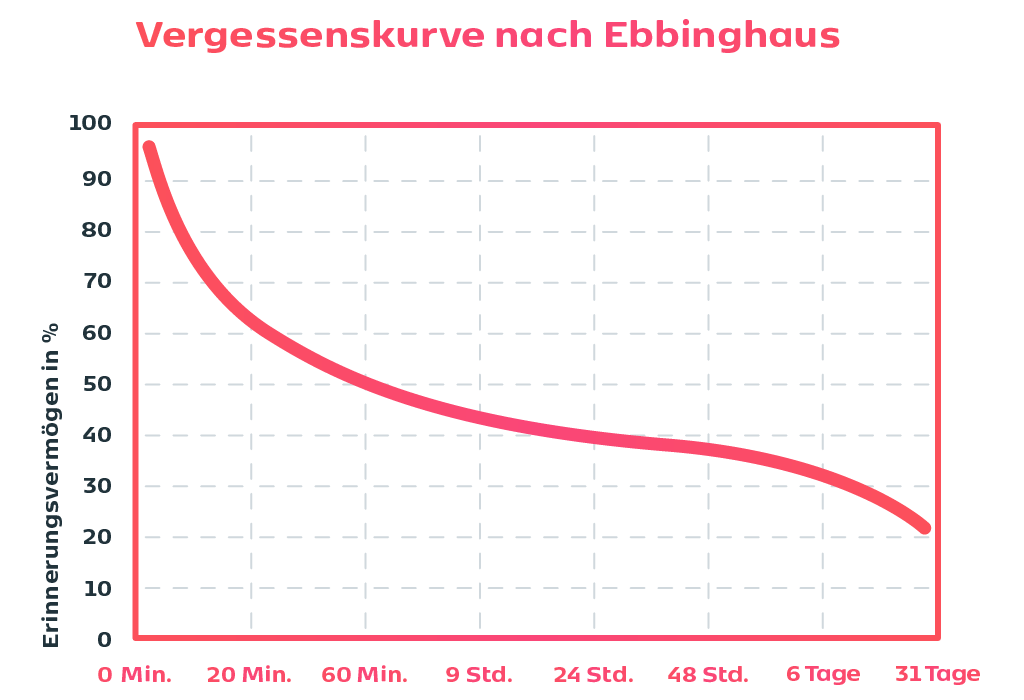
Large learning units with a high density of information often only lead to short-term memory and knowledge quickly fades. Regular review and repetition of what has been learned, on the other hand, leads to more sustainable learning results. The solution: divide learning into smaller units. This way, learners achieve significantly better results and retain the knowledge in the long term - microlearning makes it possible.
In addition to interrupting the forgetting curve, microlearning scores with these advantages:
Turn learning into an exciting experience and integrate microlearning into your everyday life. You will be amazed at how sustainable and motivating learning can be!
Imagine learning becoming an engaging part of your everyday life. This is exactly what you can achieve with small, exciting learning units that are made even more entertaining by adding gamification elements. A typical day could look like this: In the morning, you start with a short micro training session. On the way home, you consolidate and review what you have learned in a playful way with a mobile app. This allows you to break up large learning units into many small ones, which not only has didactic advantages, but also significantly increases the fun factor. Gamification makes micro learning a real highlight
Not all microlearning is the same - different formats are suitable for different learning objectives. Choosing the right format is crucial to the success of your microlearning initiative.
Video nuggets (30-90 seconds) work great for product demonstrations, process explanations or soft skills. A short talking head video by an expert can convey complex issues in an emotional and credible way. Animated explainer videos are suitable for abstract concepts or compliance-relevant topics.
Interactive quizzes and assessments test knowledge precisely and provide immediate feedback. They work both as standalone modules and as the conclusion of longer learning units. Adaptive quizzes automatically adjust to the level of performance.
Infographics and visual summaries condense complex information to the essentials. They are particularly suitable for factual knowledge, statistics or process overviews. Mobile-optimized infographics can also be consumed offline.
Audio nuggets and micro podcasts exploit untapped potential: learning while driving, doing sport or doing housework. 3-5 minute expert talks or summaries fit perfectly into small time slots.
Scenario-based simulations let learners make decisions and experience the consequences. Especially valuable for sales training, customer service or leadership development.
Not every learning objective benefits equally from microlearning The method unfolds its full effect in specific use cases. A strategic look at the best Use Cases will help you to use microlearning in a targeted manner.
Compliance and mandatory training: From a necessary evil to a motivating experience
Compliance training is the perfect microlearning candidate. Instead of three-hour GDPR training courses, 15 modules of 4 minutes each are created: "Recognizing suspicious e-mails", "Password security", "Transferring customer data". Regular "compliance refreshers" keep the knowledge up to date.
Onboarding: a gentle introduction instead of a flood of information
New employees receive new micro-modules every week instead of two-day "info dumps". Week 1: Basics, week 2: Team, week 3: Tools, week 4: Processes. Just-in-time learning delivers relevant information exactly when it is needed.
Sales training: knowledge on demand
Sales employees need up-to-date product knowledge immediately available New feature? Five micro-modules: Overview, customer benefits, objections, demo scenarios, pricing. Weekly "sales nuggets" keep the team up to date.
Management training: Continuous impulses
Leadership is learned through regular reflection, not one-off events 4 micro-modules per month (feedback, meetings, conflicts, motivation) with specific action items for practical use.
Change Management: Continuous Accompaniment
Big changes need continuous communication "Change nuggets" prepare months before go-live, explain the "why" and share success stories.
IT skills: Helping people to help themselves
Complex software becomes micro-libraries Excel training: 50+ modules for specific functions. CRM training: Situation-based modules such as "Enter new lead" or "Create report".
Where microlearning reaches its limits
**
Deep analytical skills, complex problem solving or emotionally charged topics need longer formats. Practical skills with physical components are difficult to "micro-ize". The rule of thumb: Microlearning for knowledge that is applied - less for knowledge that needs to be developed.
A striking example of the successful use of microlearning can be discovered at toom Baumarkt GmbH. The challenge was to make the mandatory work safety training more appealing.

A modular structure and gamification elements have made the learning journey more efficient and motivating. Employees can now access the learning content flexibly and complete interactive modules. With microlearning, even mandatory training can be fun. Curious? Click here for the complete Case Study:
Dr. Kim Füllenbach

Maximilian Winnen
Business Development Manager
Discover the ideal e-learning solution for you! Simply contact us via the contact form, by e-mail or call us directly. Let's get started together!