Tips for good storytelling -
telling means selling
02-01-25 | 5 minutes reading time
telling means selling
02-01-25 | 5 minutes reading time

Friedl Wynants
Founder & Managing Director
Storytelling works because our brains are evolutionarily programmed for stories. The amygdala (our “gatekeeper” to long-term memory) prefers emotional, exciting content. With the right first sentence and exciting dramaturgy, products, for example, have been proven to sell better.
Our brains love stories - and for good reason! We are all storytellers by nature. It happens automatically, our brain can't help it. To illustrate this, take a look at the following video.
What are you seeing? You're probably not just seeing simple shapes, but a little story. Perhaps you're thinking of the big evil triangle "bullying" the frightened circle or you're seeing a "dance" between them. We recognize stories even in simple shapes and give objects human characteristics. This is also known as "anthropomorphism". Anthropomorphism is when we give human characteristics, emotions, or behaviors to non-human things like animals, objects, or gods, such as saying your car is "grumpy" when it won't start or depicting cartoon animals that talk and wear clothes – or in this case two shapes moving in the same space.
But why is that? To understand why storytelling is so effective, we need to take a look inside our brains.
The amygdala is located in our brain. This small structure decides whether we remember something or not. It evaluates emotional stimuli and is closely connected to the hip-pocampus, which is responsible for memory formation. You can think of the amygdala as a gatekeeper to long-term memory - and a very strict one at that. Our amygdala is spoiled from the past: it knows stories about killing the sabre-toothed tiger, hunting in the forest and survival itself. It loves such exciting stories because they could be important for its own survival. This is why the amygdala likes to store such stories in long-term memory.
Stories stay in your head
One clear benefit of stories is obvious: if you want your target audience to remember your messages, you should tell stories. Stories evoke emotions and leave a lasting impression, while bare facts are often quickly forgotten.
The numbers say it all:
eBay experiment: From $129 to $8,000 through stories
And this insight is not only of theoretical value - it can also be put to practical use. An impressive example: In one experiment, $129 worth of Krims-krams was sold for over $8,000 on eBay by adding made-up stories. This clearly shows that "telling" can actually mean "selling".
In the following, I will introduce you to two practical tools that are not only useful in videos and e-learning courses, but also in any form of communication - be it a newsletter, a presentation or a training course. The principles of storytelling are universally applicable.
Tool 1: The perfect first sentence
As you know, we have to overcome a bouncer - and the best way to do this is with the first impression. The first sentence is therefore the most important and often the most difficult. A good first sentence grabs us, makes us curious and raises more questions than it answers. You can find an example of a successful first sentence in our explanatory film "Virtual Reality", which begins with a Star Trek quote: "Space - infinite expanses." At first glance, this introduction has nothing to do with the actual topic of the film, but it immediately captivates the viewer and arouses curiosity - far more than an introduction like "Today I'll explain VR to you".
Tool 2: Dramaturgy with narrative arc
The first step has been taken - the doorman has let you in. Now the next tool comes into play: the dramaturgy. A gripping story has to be exciting. Above all, this means that the protagonist of your story pursues a goal and encounters obstacles along the way.
Scientifically proven
A marketing professor has also proven in a study that dramaturgy is decisive for the suspense of a story. He examined 108 Super Bowl halftime commercials - the supreme discipline of advertising - and found that the popularity of a commercial depended heavily on the number of acts that were recognizable in the 30 seconds. The classic 5-act structure (exposition, plot build-up, climax, plot drop-off, resolution) proved to be particularly effective. Budweiser's "Lost Dog" commercial, which contains all the classic acts of a story, was the most popular. So you see: A well thought-out dramaturgy can make all the difference. Use this insight to make your stories even more exciting and gripping!
Why it works: Our brains are programmed for suspense. Without conflict, there is no attention; without resolution, there is no satisfaction.
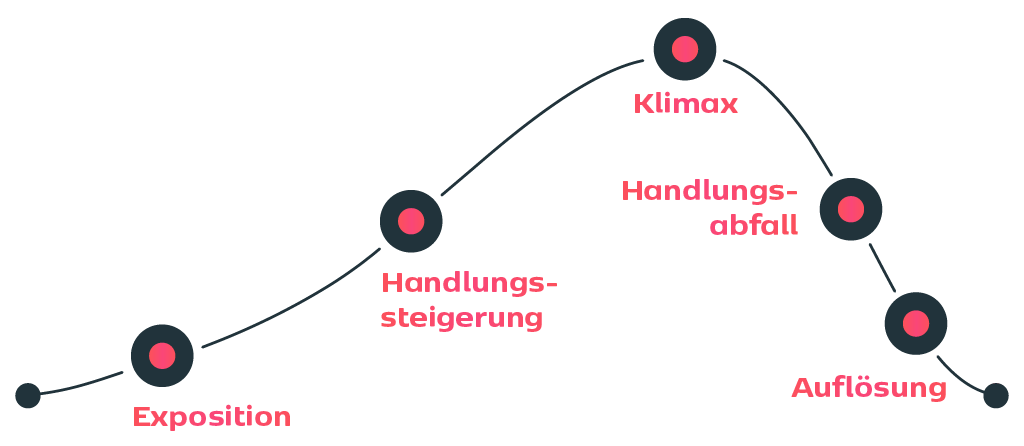
Simplified, this dramaturgy is available in the Pixar version:
Why not give this tool a try? It can basically be used for almost any content.
Practical tips on how to explain topics simply and use "storytelling" for your company.
Download our free guide and find out which tools you can use to explain topics simply and harness the power of storytelling.
ATU's goal was to use a story to spark curiosity about the topic of “climate action” – a potentially dry and polarizing subject. The result was impressive: the engagement rate was 80%, meaning that 80% of the target audience watched the film until the end. So the message was successfully conveyed.

Andreas Schatz
Key Account Manager
Discover the ideal e-learning solution for you! Simply contact us via the contact form, by e-mail or call us directly. Let's get started together!
Storytelling is the art of conveying messages through stories. It works because our brain is evolutionarily programmed for stories. The amygdala (our "memory gatekeeper") prefers emotional, exciting content and stores stories 22 times better than pure facts.
Storytelling is a technique that can be learned, not an innate talent. With the right structures (such as the Pixar formula), anyone can tell effective stories. Clear frameworks and regular practice are more important than creativity.
Yes, even particularly well! Especially in technical or traditional industries, storytelling sets you apart from the competition. B2B buyers are also people with emotions. Example: An insurance company doesn't talk about policies, but about the family that was insured after an accident.
Business storytelling always has a clear objective: to inform, convince or motivate people to take action. Every story needs a concrete message and a call to action. It's not just about entertaining, but about measurable business success.
Three proven sources: 1) Customer successes and challenges, 2) The history of your company/product, 3) Personal experiences of the founder/team. Keep a "story diary" and make a note of interesting encounters and turning points.
It depends on the context: e-mail stories a maximum of 100 words, presentation stories 2-3 minutes, video content 60-90 seconds. Basic rule: as short as possible, as long as necessary. A concise story is better than a sprawling narrative with too many subplots.
The 6-step formula works universally because it corresponds to the natural arc of tension. Even for product explanations: "Once upon a time there was a customer with problem X, he struggled with it every day until suddenly our product...". You just have to get creative with the application.
Use concrete details instead of big emotions. Instead of "The customer was thrilled", write "The customer called at 10 pm and said: \'I would never have thought that!\'" Real emotions are created by authentic moments, not superlatives.
Replace bullet points with mini-stories. Instead of "Our product saves time", say: "Customer X used to work until 8 pm, now he's home with his family at 5 pm." Use images that support stories, not just graphics and charts.
Especially good! Instead of presenting features, tell success stories of similar customers. "A customer in your situation had the same problem..." is much more convincing than technical specifications. Stories reduce sales pressure and create trust.
Have 3-5 standard stories ready that you can adapt for different situations. Use templates such as "A customer asked me the other day..." or "This reminds me of...". Over time, you will develop a repertoire of tried and tested stories.

Friedl Wynants