Learning journeys -
the right mix makes the difference
19-12-24 | 6 minutes reading time
the right mix makes the difference
19-12-24 | 6 minutes reading time

Carsten Albus
Software development
What are learning journeys and what is important when designing them? Carsten Albus, e-learning product manager at youknow, answers these and other questions in this article.
For us, a learning journey is a compilation of different learning units. These learning units can in turn include different training methods - from Micro Nugget to Explanatory videos to face-to-face workshops or webinars, anything is possible. When developing a learning journey, we always take into account which learning methods and technologies the customer already has in place and combine these with the learning nuggets we create.
Our learning journeys naturally use the methods of Blended Learning. When developing a learning journey, we consider which learning content should be taught via face-to-face training and which content can be taught more efficiently via online training.
In a blended learning environment, it is common for the basics to be taught first via online training. Action-oriented content, on the other hand, is taught via face-to-face training and social interactions are practiced. This is also the standard for us.
What goes beyond classic blended learning in our learning journeys is the special structure - in the sense that we not only want to impart knowledge in a targeted manner, but also want to ensure that the learning journeys are used again and again afterwards. In concrete terms, this means that certain learning nuggets or recaps from the learning journey can also be accessed after the training if required - in line with the Microlearning approach. This strengthens sustainable knowledge transfer and reflection. We therefore see learning journeys as something that actually has no end.
For example, we would permanently expand the learning journeys for regulatory training. This is because employees are required to provide regular evidence of their knowledge, especially when it comes to topics such as data protection or occupational safety. In such cases, we would then provide employees with recaps at later dates to refresh what they have learned and provide new training stimuli. However, this does not involve repeating the entire training course, but rather a case study. If the learner does not answer this case study correctly, they are encouraged to do the training again.
Another aspect that sets learning journeys apart from blended learning is the communicative level. We don't just focus on knowledge transfer, but also on training marketing, i.e. the entire communication surrounding the training. Our first aim is to make employees aware of the training and ensure a high level of acceptance. They should also be motivated to complete the training. This can be achieved through an explainer video, for example, which is distributed via internal communication channels such as the intranet.
Training marketing plays an important role and is often even crucial to success, especially when it comes to topics that meet with a high level of resistance, such as change processes. This is why we also take this aspect into account when designing learning journeys.
You can find out how to get employees interested in corporate learning and increase the acceptance of e-learning in your company in our article on the topic E-learning acceptance.
Whether a blended learning scenario is suitable or pure online training is more efficient depends primarily on the learning objectives. For training courses with fact-oriented learning objectives ("The learner can reproduce the content as given"), online training is the best option. For example, face-to-face training is almost no longer necessary for regulatory training such as data security.
If the learning objectives are action-oriented ("The learner can transfer what they have learned to a different context"), it makes sense to convey learning content via face-to-face training. If, for example, a new process is to be introduced in the area of employee appraisals, then this process is usually not taught purely descriptively, but also practiced practically - role-playing in face-to-face training is a good way to do this.
Since both fact-oriented and action-oriented learning content often needs to be taught together, blended learning scenarios often arise.
We have developed a topic/module matrix in which we divide the training world into six types. On one axis, we look at the training content and assign it to the appropriate type: Regulatory, Process/Software, Technical, Product, Skill/Behavior, Change/Transformation.
The second axis shows the phases of the knowledge acquisition model: acceptance creation, knowledge acquisition, application/reflection and knowledge transfer.
Depending on the training content and the customer's learning objectives, there are different areas in the matrix for which we derive recommendations regarding suitable training methods.
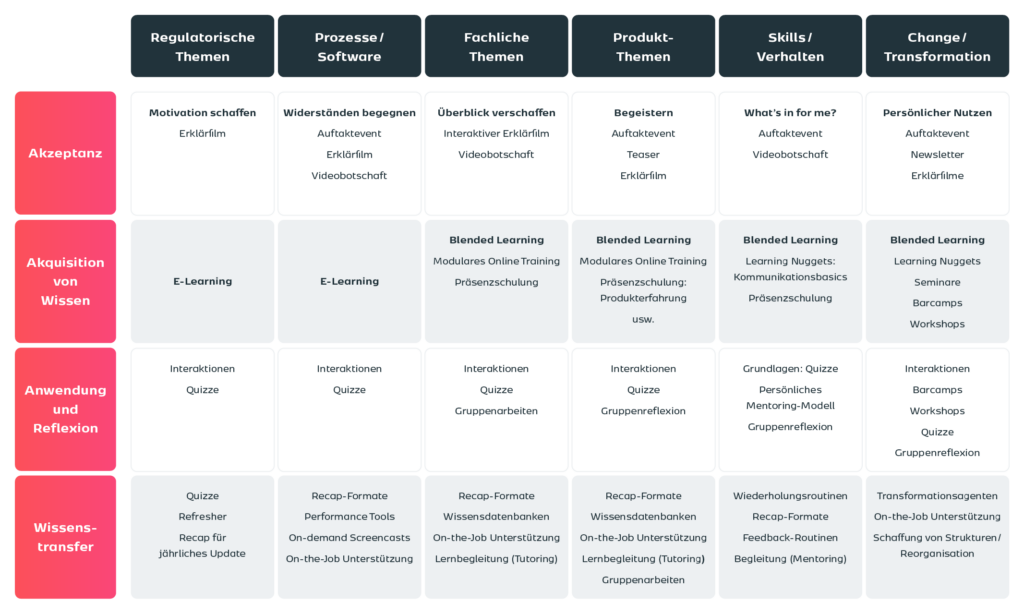
Firstly, you need to know the target group and their needs precisely. As the target group is usually heterogeneous, it is important to create the best possible training experience for each individual learner. The knowledge levels and interests of employees can vary greatly, especially in the case of specialist training. It is therefore important to first determine the level of knowledge of the individual learners in order to then recommend the right learning content for them.
For regulatory and procedural topics, on the other hand, target group-specific training is often not necessary, as the learning content is generally relevant for everyone and is often even mandatory. The main objective here is to convey the information as concisely and comprehensibly as possible.
Another important aspect in the design of learning journeys is the penetration of the target group. Here we ask ourselves questions such as: What is the best way to reach the target group? Are mobile devices available to them? Is a LMS in use? What hardware and system requirements are there? We then take all of this into account when developing a learning journey.
And last but not least, a learning journey must be easy to integrate into everyday working life. Because the target groups have one thing in common: time for concentrated learning is scarce in everyday working life - most employees don't have more than 20 minutes at a time for training. The keyword here is "micro learning": we structure learning journeys in such a way that they can be optimally integrated into everyday working life in the form of compact learning nuggets. For example, we divide a one-hour training course into short learning nuggets with a maximum learning time of 20 minutes.
To develop an optimal learning journey for the customer, we ask ourselves the following questions, among others:
Ideally, we already have an idea of the topic to be taught before the first customer meeting. During the first consultation, we then work with the customer to develop ideas for implementing a learning journey. Our consulting approach is based on two instruments: The knowledge acquisition model and the topic/module matrix just mentioned.
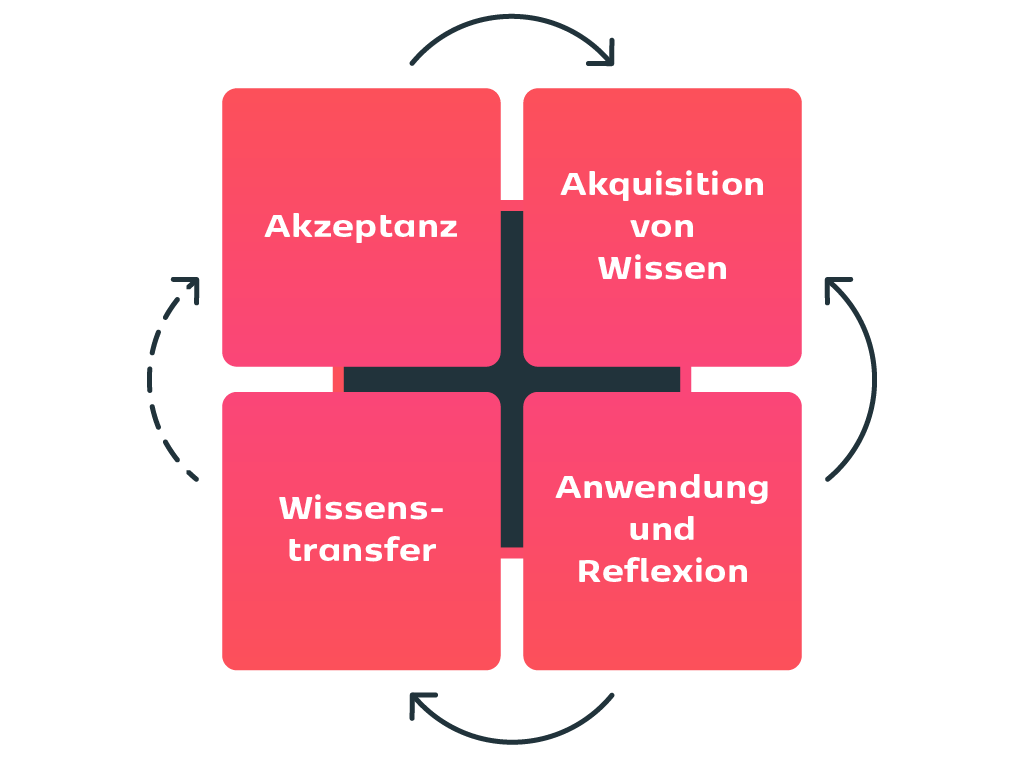
We present these two tools to the customer and ask them to categorize their topic themselves. This is very helpful, as the customer often categorizes their topic differently than we do from the outside. Especially when there are behavior-oriented learning objectives, this is often not apparent to us as outsiders.
Once we have categorized the topic in the matrix together with the customer, we derive recommendations for action regarding the training types in the matrix. We always keep an eye on what training methods the customer has already established and consider how we can combine these with the new learning units to be developed. We also consider which systems and technologies the customer has in place and how we can use them - from LMS to collaborative tools and webinar systems.
This results in an initial rough concept - i.e. ideas for the individual phases and a resulting learning journey. This is the first step in the customer project.

Carsten Albus

Andreas Schatz
Key Account Manager
Discover the ideal e-learning solution for you! Simply contact us via the contact form, by e-mail or call us directly. Let's get started together!