LMS introduction:
11 questions you should ask yourself beforehand
20-08-26 | 10 minutes reading time
11 questions you should ask yourself beforehand
20-08-26 | 10 minutes reading time

Carsten Albus
Software development
Implementing an LMS is not just an IT project, but also – or above all – a change process. The most important requirements are: defining clear goals, involving all stakeholders, and planning budgets and resources realistically. It is crucial to ask the right questions beforehand: What do we want to achieve? Who will use the system and how? Which functions are really necessary? Without strategic planning, LMS projects are doomed to fail.
"Let's introduce 'e-learning', that's what everyone is doing right now!!!" There are always digital trends that everyone wants to get into. Some of them hardly think about what they need it for and whether it is even useful.
A Learning Management System (LMS) is the infrastructure that makes it possible to manage and deliver learning content - for specific target groups, tailored to their needs and ideally at exactly the right time. For most companies, the introduction of an LMS is a change process and also a significant investment - in terms of time as well as human and monetary resources. Before you introduce an LMS, you should therefore identify the needs and goals of your company and, above all, your users. Here are 11 questions you should ask yourself before introducing a new LMS to ensure the project is a success.

As a first step - before you tackle everything else - you should ask yourself the following question: Why do we need a (new) LMS and what do we want to achieve with it?
There are different goals depending on the use case. If you are using the LMS internally, possible goals could be to onboard new employees faster and more sustainably, to reduce employee turnover through attractive training opportunities, or to get a better overview of the employees' level of knowledge in order to develop personal development plans. If you would rather use the LMS for product training, one goal could be to increase sales by better training sales staff or affiliated trading partners. Another goal could be to reduce the dependency on classroom training and thus reduce training costs by offering online courses in addition to classroom training (keyword "blended learning"). An LMS also helps you sell training to the outside world, open up new sales channels and markets and scale your business.
Only when you are aware of your goals you can you better narrow down the requirements for the LMS and better evaluate the results of the implementation.
In the second step, you should ask yourself whether you have sufficient resources to handle such a project. You should also clarify whether your resources have sufficient skills and know-how. In concrete terms, this means: Do you have someone in IT who has an overview of the system landscape in your company and the relevant technical knowledge? There should also be sufficient resources available in the specialist departments, in HR and communications and other relevant departments - these are the groups that you need to pick up when introducing an LMS in any case. And don't forget: depending on the size of the company, the works council plays a not insignificant role, so remember to involve them at an early stage.
The third question goes hand in hand with the first question. Most organizations need an LMS because they have specific challenges to overcome. It is important to identify what specific problems or pain points exist in the process that you want the LMS to alleviate. For example, this could be a lack of accessibility to training, inadequate tracking of training results, or a lack of efficiency in managing learning materials. Once you have identified your pain points, you can ensure that you select the LMS that provides the features and tools relevant to you to effectively address these issues.
This question helps you to determine the financial framework for your LMS implementation. A higher budget will allow you to purchase a more comprehensive and powerful system, while a lower budget may result in more limited functionalities. The latter doesn't have to be worse: depending on your specific requirements, you may not even need a "big" LMS with features you'll never use. However, it is important that you consider your budget when choosing an LMS to ensure that you purchase a tool that meets your needs and is within your means, but budget should never be the only deciding factor. Other important aspects are the requirements of your stakeholders (see question 6) and whether the tool fits into your existing system landscape (see question 7).
At its core, this question focuses on the strategic direction of your educational work. Will you only use the Learning Management System internally, to train your own employees, or will you train affiliated partners and customers, or do you even want to sell learning content? It is important to determine whether the LMS will only be used by your own employees or whether external people such as customers, dealers or partners should also have access. You should also identify how administrators, course instructors, department managers and learners will use the LMS. These points also determine which functionalities the LMS must have, e.g. store functions, gamification features or certain verification and certification processes.
The requirements for an LMS vary between the different stakeholder groups. The group is much larger than you think - because stakeholders are not just the learners. Depending on how you want to use the LMS, you will have different stakeholders.
In any case, you must involve the IT or administrators in the decision. If you want to offer in-house training and further education for your own employees, you should always include the requirements of personnel development, specialist departments, content owners and possibly also the works council, for example. If you mainly want to train external parties, e.g. dealers or partners, you should consider the needs of the respective regional or sales management. These can be technical requirements such as availability on different devices, but also didactic requirements such as the design of interactive learning content. It is important to identify and consider these requirements in order to develop an LMS that meets the needs of all (stakeholders) Involve the administrators and learners, especially in the test phase, and get their feedback. Because the best tool is useless if it is not used.

This question refers to the technical requirements that must be met in order to use the LMS effectively. These include, for example, the hardware, software and network capacity requirements. It is important to check these in advance to ensure that your company has the necessary infrastructure to use the LMS effectively. Pay particular attention to the systems to which there should be any interfaces to the LMS, such as HR, CRM tools or invoicing systems. If you want to sell learning content via the LMS, for example, there should be an integration with your existing CRM. This allows you to provide your customers with an optimal purchasing experience. If you synchronize the data from both systems, you can process your users' information from the LMS directly in the CRM. On the one hand, this saves time because you don't have duplicate data storage, and on the other hand, it reduces the susceptibility to errors when entering data.
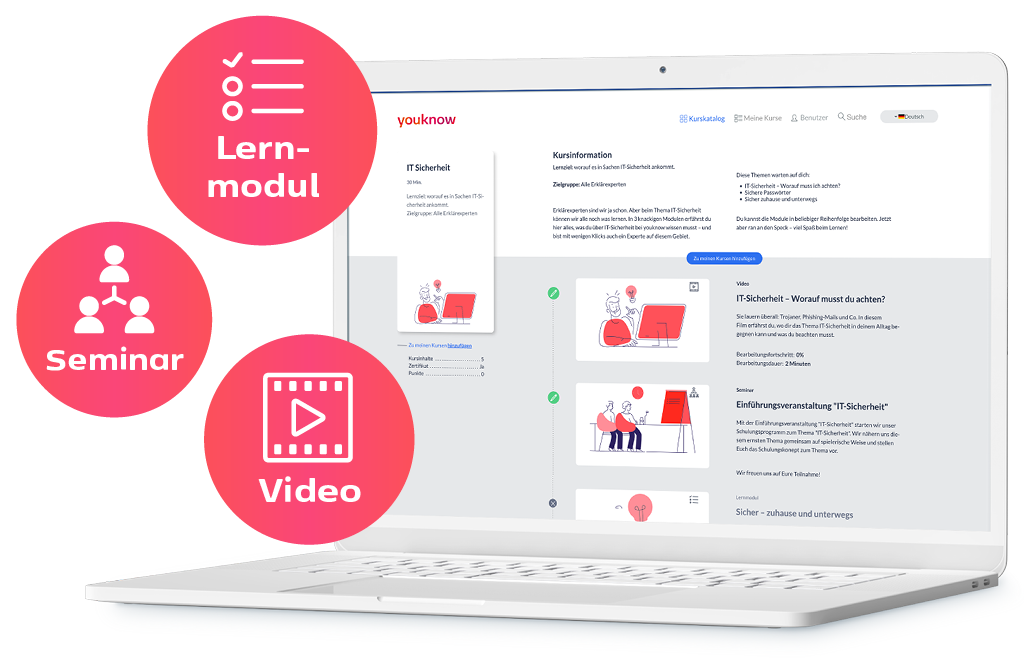
There are three scenarios for learning content:
In all three scenarios, you can include any type of learning format, from face-to-face training to micro nuggets, videos, tests and more Depending on which scenario you choose, this can affect the functionality requirements of the LMS, e.g. whether you can embed content via remote SCORM or do a SCORM upload, whether you can combine content into courses and learning journeys, and whether multimedia is supported. It also has an impact on how many resources you will need to create and manage the content.
You should define the most important - also future - functions of your desired LMS from the outset to ensure that the chosen system meets all your requirements. Functions that are absolutely necessary should be identified as must-haves, while functions that are not absolutely necessary but are still desirable can be described as nice-to-haves. A Request-for-Information (RFI) Document, i.e. a structured request for information to various providers, can help with prioritization.
The most important stakeholders should always be involved in defining the required features (see question 6). Different business areas have different requirements for the LMS. E-learning in education and training requires different functions than e-learning for regulatory training. E.g. documentation and verification options play an important role in the latter. The requirements for e-learning in administration are also different from those in production companies, etc.
But don't forget another important aspect: sustainability - don't just plan for the moment, but for the long term. You may not need certain functions yet, but they may become relevant later when the user base expands. So choose an LMS that is scalable and expandable and also adapts to growing needs and requirements.
By considering the various factors, you can prioritize more easily and ensure that you find the LMS that meets the most important needs of your company and your users. But be aware of one thing: you will never find the jack of all trades.
Data protection and data security are important issues, especially when managing sensitive information such as personal data of employees and customers. It is important to check how the selected LMS ensures data protection and data security, including the location of the servers where the data is stored and the measures taken to encrypt and prevent unauthorized access to data. Since the GDPR came into force, you are taking the safe route with a tool hosted in the EU or Germany.

Last but not least: Determine early on who will be responsible for the management and operation of the LMS, including updating and maintenance. It is also important to consider who will be the first point of contact for problems and questions and who will provide support to resolve issues. This can be internal or through an external service provider. IT should definitely be involved from the outset and their role should be defined and communicated after implementation, i.e. during ongoing operations. Also train the course administrators in good time so that they can answer user questions or questions about the course processes and content. Summarized: Involve all relevant groups of people at an early stage.
In most cases, introducing a Learning Management System is a major project. Even before you install the LMS, you should ask yourself a few key questions to help you identify your specific goals and pain points, clarify technical requirements and ensure data security. You should never forget the needs of your users. By answering all these questions from the outset, you can ensure that you choose the right LMS for your organization and that the implementation is a success.
And one final tip: Remember to consider all stakeholders and learners involved early on in the communication and introduce them to the new system in phases. Read more about this in our article .
You might also like these three articles

Carsten Albus

Ken Weid
Key Account Manager
Would you like to experience our LMS in action? Arrange your personal demo now and let our professionals guide you through the solution.