The EU AI Act
What L&D Teams Need to Know Now
Deadlines | Providers & Deployers |
Risk Categories | AI Literacy | Glossary
Deadlines | Providers & Deployers |
Risk Categories | AI Literacy | Glossary

The EU AI Act is the world’s first comprehensive piece of legislation to establish clear rules for the development and use of AI systems. Unlike many other tech regulations, the EU AI Act takes a risk-based approach: the higher the risk an AI system poses to fundamental rights and safety, the stricter the requirements and compliance standards.
The law applies not only to tech giants but to every company in the European Union that offers or uses AI systems—from automated recruitment to AI-powered learning programs. In other words, virtually every company, regardless of size or revenue. For L&D professionals, this means, in concrete terms, that they are responsible for establishing a clear set of rules for the legally compliant use of AI in training and professional development—but at the same time, it also presents a strategic opportunity to establish AI expertise as a competitive advantage within their own organization.
Background and Objectives
AI is transforming our world of work faster than any other technology before it – however where there are opportunities, there are also risks. The EU AI Act was created to promote innovation while protecting European fundamental values and fundamental rights. The European Union is thus setting a global standard for trustworthy, ethical, and human-centered AI systems.
Here are the three main reasons behind the creation of the EU AI Act:
The EU AI Act will not be fully implemented overnight—it will be rolled out in phases to give companies and organizations sufficient time to adapt their processes and systems. L&D teams should definitely keep an eye on this timeline:
July 12, 2024: Official entry into force of the EU AI Act upon publication in the Official Journal of the European Union February 2, 2025: Application of the prohibitions on impermissible AI practices, as well as the obligation to build AI competence (Article 4) and the general principles August 2, 2025: Entry into force of the provisions on notified bodies and governance structures August 2, 2026: Full application of most regulations, including requirements for high-risk AI systems and transparency obligations August 2, 2027: Deadline for compliance with the requirements for general-purpose AI models placed on the market before August 2025 August 2, 2030: Latest date for full compliance of high-risk AI systems used by public authorities
The EU AI Act clearly distinguishes between different actors in the AI ecosystem, each with distinct responsibilities. Understand your role so you can take the appropriate compliance measures:
Under the EU AI Act, you are considered a deployer if you use AI systems under your own responsibility. Most L&D departments primarily fall into this category when they use off-the-shelf AI solutions for training and talent development.
Typical examples of L&D acting as “operators” of AI systems:
Operator Obligations Under the EU AI Act:
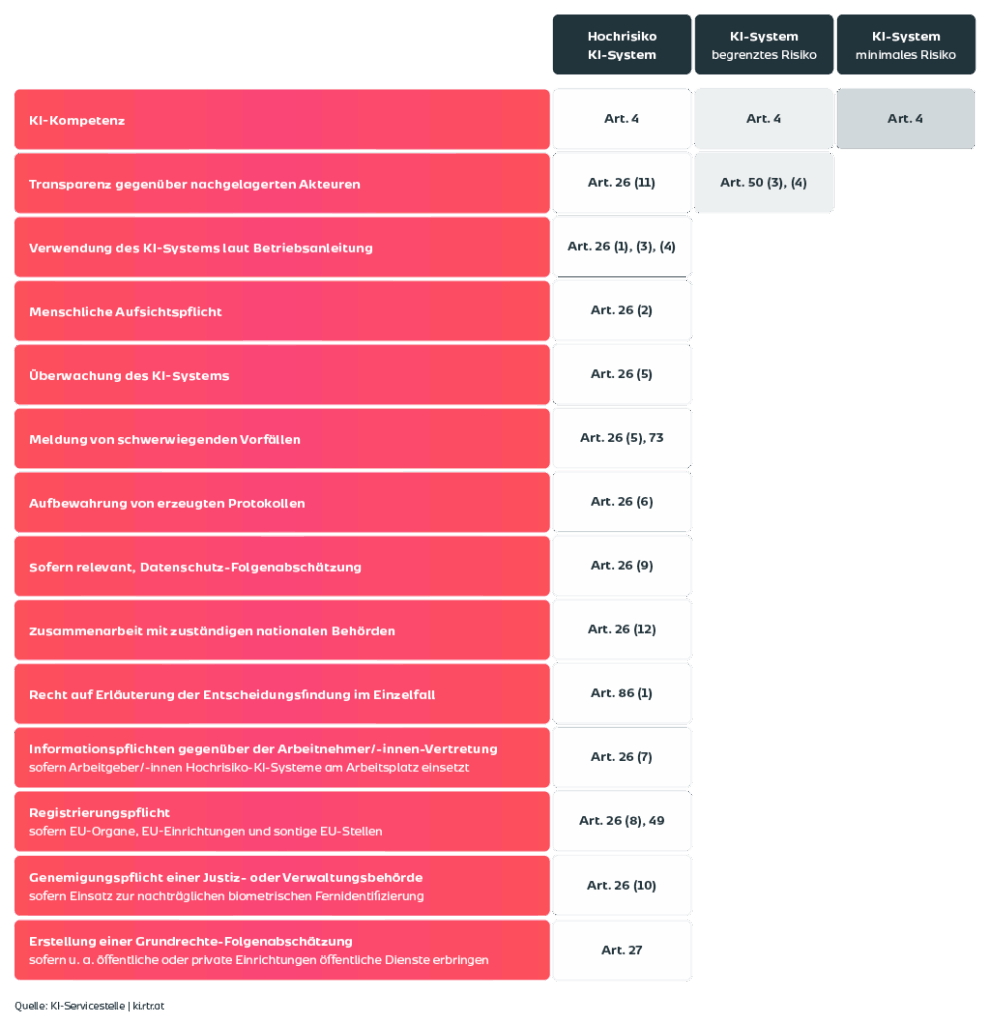
Download an overview of operator obligations as a PDF (German)
Under the EU AI Act, you are considered a provider if you develop or place AI systems on the market. This also applies to L&D teams that develop, significantly modify, or repurpose their own AI solutions.
When is an L&D team considered a “provider” under the EU AI Act?
Provider Obligations Under the EU AI Act:
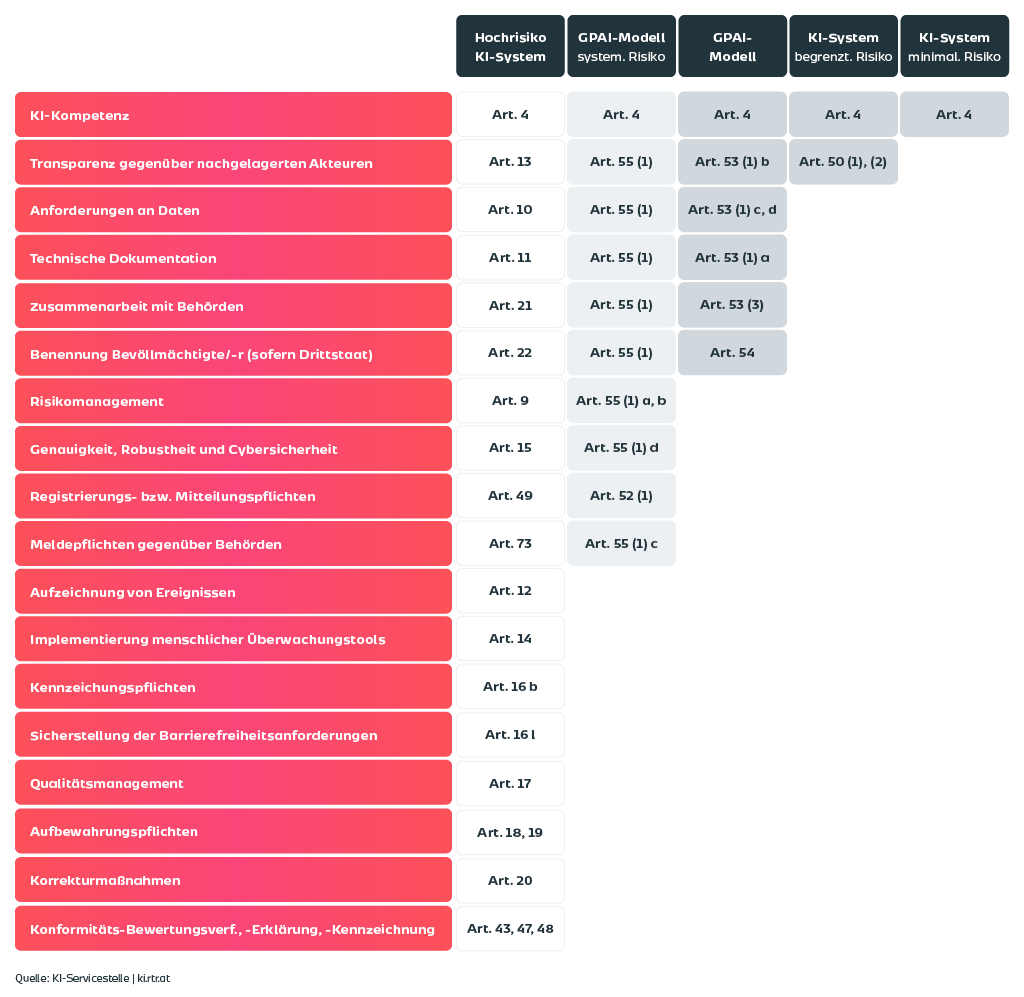
Download an overview of provider obligations as a PDF (German)

What They Mean for L&D
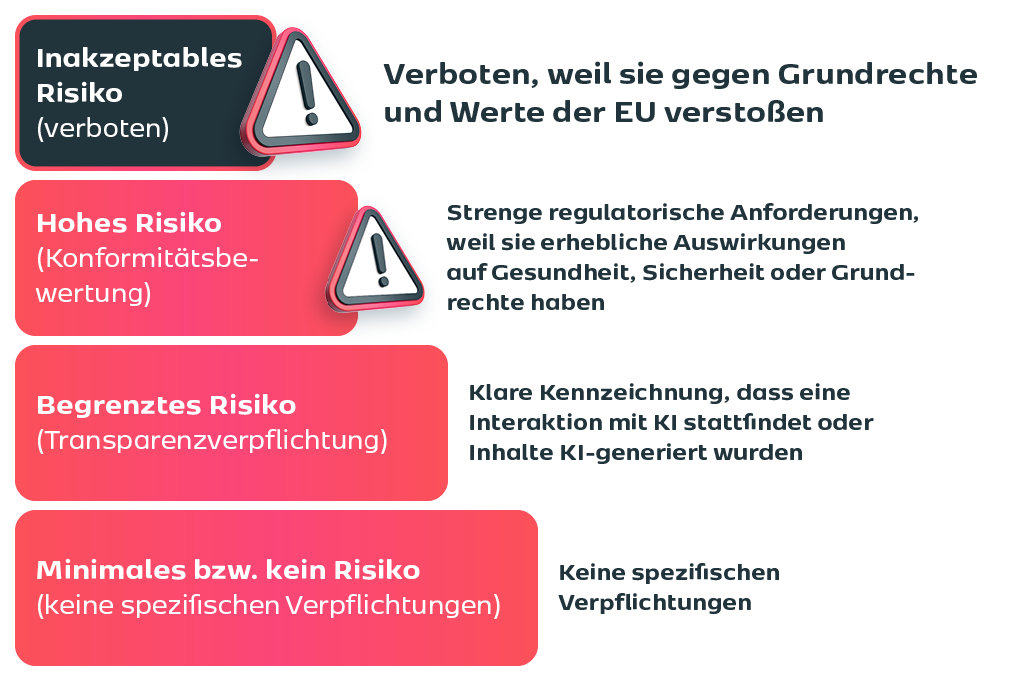
The risk-based approach of the EU AI Act classifies AI systems into four categories—ranging from prohibited to minimal risk. This classification determines which legal requirements apply to your L&D tools:
Certain AI applications are generally prohibited in the EU, including in the fields of education and training, because they violate fundamental rights or pose unacceptable risks to individuals:
L&D Relevance: Carefully verify that your learning and assessment tools do not contain prohibited techniques such as unconscious manipulation, abusive emotion recognition, or discriminatory social scoring.
These AI systems must meet strict regulatory requirements, as they can have a significant impact on individuals’ health, safety, or fundamental rights:
L&D Relevance: Many advanced L&D tools that evaluate employees, provide career recommendations, or make decisions about development paths fall into this category, which is subject to comprehensive compliance requirements.
These AI applications must clearly and unambiguously indicate that an interaction with artificial intelligence is taking place or that content has been generated by AI:
L&D Relevance: Your digital learning assistants, AI coaches, and automatically generated learning materials must be clearly labeled as AI-generated or AI-supported for users in order to comply with transparency requirements.
Most simpler AI applications fall into this category and are not subject to any specific obligations under the EU AI Act, but only to general principles:
L&D Relevance: Even with these systems, which pose minimal regulatory risk, you should pay attention to data protection, fairness, and ethical considerations to implement best practices—even if there are no specific legal requirements.

Key Requirement for L&D
Article 4 of the EU AI Act explicitly emphasizes the fundamental importance of AI literacy for all stakeholders—and this is where Learning & Development teams come into play, as education and training are key to meeting this central requirement.
AI competence encompasses the structured knowledge, practical skills, and critical understanding needed to:
The need to develop and promote AI literacy applies to various target groups within organizations:
While promoting AI competence under Article 4 of the EU AI Act is a mandatory requirement, in practice it is more of a recommendation. Unlike direct violations of specific technical requirements, no immediate fines are currently provided for in this case. However, this does not mean you should ignore this provision.
The real risk arises in the event of damage: If an inadequately trained employee causes damage through the improper use of an AI system, your company could be accused of violating its general duty of care. In such cases, the lack of evidence of systematic AI training may be viewed as a failure to take appropriate precautionary measures and could result in liability consequences.
Therefore, it is advisable to view AI competency development not merely as a formal requirement, but as an important safeguard against legal and financial risks. In the event of an incident, a documented training program serves as crucial evidence that you have taken your duty of care seriously.
Become EU AI Act-compliant now and equip your team for the future of AI
Article 4 of the EU AI Act requires that your employees have sufficient AI expertise. With our certified training packages—ranging from the 45-minute e-learning course “AI Fundamentals” to personalized coaching for your specific Use Cases—you can ensure your team is legally compliant and ready to meet the AI requirements of the future. Learn more now!

A person or organization that develops or markets AI systems. In L&D, you would be considered a provider if your team develops its own AI learning assistant or significantly modifies an existing AI tool.
A person or organization that uses AI systems in its operations. Most L&D departments are operators when they use off-the-shelf AI tools, such as ChatGPT, to create training materials or AI-powered learning platforms.
GPAI models (General Purpose AI) are flexible AI systems capable of performing many different tasks—like a Swiss Army knife among AI programs. While specialized AI can do only one thing (such as sorting photos or translating text), GPAI models can simultaneously generate text, perform calculations, create images, and hold conversations. ChatGPT is a typical example: It can write poetry, help with math problems, and create travel itineraries. The EU AI Act pays particular attention to these versatile AI systems because their broad range of applications means they can have a greater impact. Providers of such all-purpose AI systems must therefore carefully verify that their systems are safe and transparently explain what their AI can and cannot do.
An AI application that poses significant risks to health, safety, or fundamental rights. In the field of learning and development (L&D), this includes AI systems that determine career opportunities, evaluate important exam results, or control access to educational programs.
The knowledge and skills needed to use AI systems responsibly, understand their capabilities and limitations, and identify risks. The EU AI Act requires companies to foster these competencies among their employees.
Software developed using machine learning techniques, logic- or knowledge-based approaches, or statistical methods, capable of generating content, predictions, decisions, or recommendations that can influence human behavior.
Simply put: Imagine the difference between two different chefs: An AI system is like a chef who learns from experience, constantly adapts their recipe, and can try something new with every dish. A normal computer program, on the other hand, always follows the exact same recipe without any deviations.
Examples of AI systems:
The following are not AI systems under the EU AI Act:
The key difference lies in whether the software can generate content or make decisions on its own that were not precisely preprogrammed, and whether it learns from data and evolves over time.
Ensure that a human always retains control over an AI, understands its decisions, and can intervene when necessary. This oversight must be guaranteed, particularly for high-risk AI.
AI applications that are generally not permitted because they are too risky or unethical. These include AI systems designed to manipulate people, conduct comprehensive social assessment, or carry out covert biometric surveillance in public spaces.
Just ask our EU AI Act chatbot and navigate the legal jungle with confidence.

Jacques Alomo
Head of AI Innovation
Curious about how AI can revolutionize your L&D strategy? Our team of AI experts is ready to help you. Let's chat about your visions, challenges and goals. Get in touch today - let's start your exciting AI journey together!
Information as of: April 10, 2025
Note: This information regarding the EU AI Act does not constitute legal advice and is not a substitute for consulting with an attorney specializing in AI law. The content has been compiled to the best of our knowledge and belief, but is not intended to be exhaustive. We recommend consulting with legal experts if you have specific legal questions regarding the EU AI Act and its impact on your L&D processes.