Blended Learning:
E-learning meets presence
11-12-21 | 5 minutes reading time
E-learning meets presence
11-12-21 | 5 minutes reading time

Susanne Weisse
Customer success
Blended learning (hybrid learning) is the combination of virtual (e-learning) and non-virtual (presence training) learning units. It thus combines different methods and media - from web-based training, explainer videos, instructional videos and learning nuggets to workshops and face-to-face training. Blended learning thus combines the advantages of e-learning with the benefits of traditional face-to-face training while avoiding the disadvantages that the respective methods and settings can entail.
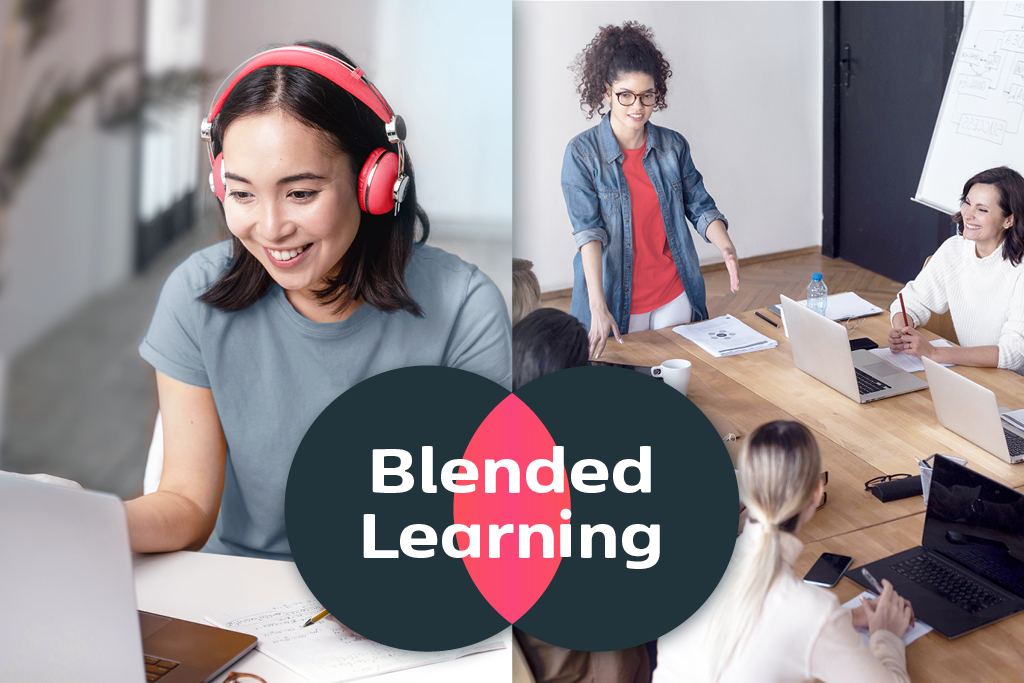
We all remember it from school lessons: The learning content is first taught in class by the teacher, after which the homework is done at home and the learning content is practiced again independently. Blended learning is based on the "flipped classroom" (or "flipped learning") model: the basics are first taught via online training, after which what has been learned is practiced and reflected on in face-to-face training. This has the advantage that the learners can first deal with the learning content themselves - when and where they want and at their own pace. In face-to-face training, learners usually have the same level of knowledge, so that the focus can be fully on practice-intensive or behavior-oriented topics, which can be practiced with interactions and role plays, for example. In addition, learning content that may have caused problems for learners during e-learning or that is particularly relevant can be dealt with in greater depth and questions can be clarified directly with the teaching staff.
Use of blended learning scenarios
Universities, training centers and schools use blended learning as an integral part of their teaching concept. However, blended learning is particularly suitable in a professional context for training and further education of employees and/or partners, as the self-directed online training units can be optimally integrated into everyday working life. One of the biggest levers in this context is micro learning. Short, crisp learning units interrupt the so-called "forgetting curve" and ensure a permanent and sustainable deepening of knowledge.
Of course, whether e-learning is suitable for teaching the basics depends heavily on the topic. Digital training is ideal for training courses with fact-based learning objectives ("The learner can reproduce the content as given") - for example, for regulatory topics such as data security or compliance issues.
Why blended learning? Blended learning combines the advantages of both methods through the sensible dovetailing of e-learning and face-to-face training. We briefly outline these below.
Blended learning integrates different types of learning
Blended learning appeals to all types of learners and each learner can choose the learning method that is best for them. E-learning modules can include a wide variety of learning formats - from video to quizzes, interactions and podcasts to webinars. Direct contact with teaching staff can also be made possible via online training: In tutorial support, teaching staff are available to provide support in digital training, for example in chats; web meetings or virtual classrooms. In face-to-face training, the focus is then on interactions between learners and personal exchanges with teaching staff, e.g. in group work, workshops or role plays. In this way, blended learning appeals to all types of learners, which increases motivation and learning success.
Blended learning means the same level of knowledge for everyone
In the face-to-face phase, learners have at best the same level of knowledge, as they have all completed the e-learning beforehand. This means that learners are neither over- nor underchallenged in face-to-face training.
Blended learning means self-determination and flexibility
The right mix of e-learning and face-to-face training as well as different media is crucial for successful blended learning. But how do you find the optimal mix? We have developed a topic/module matrix that helps us to design blended learning scenarios or so-called learning journeys. For us, a learning journey is a compilation of different learning units, which in turn can include different training methods. Our learning journeys make use of blended learning methods, but go even further. You can find out exactly how learning journeys differ from blended learning, when which mix of online training and face-to-face training is suitable and how we design blended learning scenarios or learning journeys in our article on the topic of "learning journeys".
You have the goals, we have the solutions – together we will find the best one for you.