AI competence -
From a niche to the most important learning topic
19-05-25 | 4 minutes reading time
From a niche to the most important learning topic
19-05-25 | 4 minutes reading time

Friedl Wynants
Founder & Managing Director
The recently published mmb Trendmonitor 2024/2025 shows a change in the vocational training landscape that was only a matter of time: Artificial intelligence tops the list of key learning topics for the first time, a paradigm shift that heralds a new era after years of dominance by "classic" IT skills. While IT applications now only rank 4th, AI has taken the lead with an average score of 1.7 and has even relegated future skills (such as media skills and creative problem solving) to second place.
KI-Kompetenz beschreibt die Fähigkeit, Künstliche Intelligenz sicher, kritisch und verantwortungsvoll im Arbeitsalltag einzusetzen. Dazu gehören technisches Grundverständnis, die richtige Anwendung von KI-Tools sowie die Einordnung ihrer Chancen, Risiken und Grenzen.
First of all, I would like to say that I think it makes a lot of sense that "AI skills" are not subsumed under the diffuse term of future skills in the study. AI is already very concrete and relevant today, and I am convinced that in a few years' time we will think of AI training in the same way we think of computer driving licenses today - as a self-evident and integral part of our professional qualifications
With the EU AI Act, AI competence has now even become mandatory training, and it makes perfect sense for corporate learning professionals to start by addressing these legal requirements. They can be a valuable starting point on the path to "true AI competence ". After all, the AI Act requires targeted tailoring to the prior knowledge, field of activity and risk class of the learners - the "one size fits all" principle does not work here.

However, it would be fatal to see AI expertise as just another annoying compulsory training course alongside data protection, occupational safety, etc. Anyone who thinks this way completely fails to recognize the transformative potential of AI. AI is by no means just a skills issue, but a transformational issue for every individual and for entire organizations.
Dass KI-Kompetenz heute weit mehr ist als ein freiwilliges Zukunftsthema, zeigt auch der EU AI Act. Mit der europäischen KI-Verordnung rückt das Thema erstmals in einen regulatorischen Kontext.
Artikel 4 des EU AI Act verpflichtet Anbieter und Betreiber von KI-Systemen dazu, sicherzustellen, dass die Personen, die mit KI arbeiten, über ein ausreichendes Maß an KI-Kompetenz verfügen. Wie Unternehmen diese Kompetenz vermitteln, schreibt das Gesetz bewusst nicht vor. Klar ist jedoch: Organisationen sollten sich frühzeitig mit dem Kompetenzaufbau beschäftigen.
Der AI Act sollte dabei nicht als reine Compliance-Anforderung verstanden werden. Unternehmen, deren Mitarbeitende KI sicher und kompetent einsetzen können, profitieren nicht nur von einem geringeren Risiko, sondern auch von besseren Ergebnissen und einer höheren Akzeptanz im Arbeitsalltag.
Traditional mandatory training such as compliance, fire protection or data protection is usually about minimizing risks. AI competence, on the other hand, aims to exploit opportunities AI will become such an inevitable and integral part of our work that Learning & Development will have to take a completely different approach here.
I therefore see the AI Act and its Article 4 on mandatory training as a welcome opportunity to take a serious look at the question: How can we build the necessary AI skills in people? Not as a bureaucratic compulsory exercise, but as a strategic investment in the future viability of companies and their employees.
The results of the study thus confirm a trend that I have been observing for some time: AI skills are not just one new topic among many, but a fundamental building block for the vocational training of the future. And if I may be so self-promotional at this point: You can find our solutions for building AI skills in your company here.
You can download the current trend monitor here.
Für Unternehmen stellt sich heute nicht mehr die Frage, ob sie KI-Kompetenz aufbauen sollten, sondern wie.
Der erste Schritt ist eine gemeinsame Wissensbasis. Mitarbeitende sollten verstehen, wie KI-Systeme funktionieren, welche Chancen sie bieten und wo ihre Grenzen liegen. Genauso wichtig ist es, den verantwortungsvollen Umgang mit KI zu vermitteln – von Datenschutz und Urheberrecht bis hin zum kritischen Umgang mit KI-generierten Ergebnissen.
Mindestens genauso entscheidend ist jedoch die Anwendung in der Praxis. Erst wenn Mitarbeitende KI regelmäßig im Arbeitsalltag einsetzen und Erfahrungen sammeln, entwickelt sich aus Wissen echte Kompetenz.
Deshalb sollte KI-Kompetenz nicht als einmaliges Schulungsprojekt verstanden werden, sondern als kontinuierlicher Lernprozess, der sich mit der technologischen Entwicklung weiterentwickelt.
KI-Kompetenz entwickelt sich zu einer Schlüsselkompetenz für nahezu alle Organisationen. Der EU AI Act unterstreicht diese Entwicklung zusätzlich, der eigentliche Antrieb sollte jedoch nicht die Erfüllung gesetzlicher Anforderungen sein.
Unternehmen, die ihre Mitarbeitenden frühzeitig für den sicheren und verantwortungsvollen Umgang mit KI qualifizieren, schaffen die Grundlage dafür, die Potenziale Künstlicher Intelligenz langfristig erfolgreich zu nutzen.
Ein KI-Grundlagen-Kurs bildet dafür häufig den Einstieg. Er vermittelt das notwendige Basiswissen, auf dem Unternehmen den weiteren Aufbau von KI-Kompetenz systematisch aufbauen können.
Den Trendmonitor 2024/2025 können Sie sich übrigens hier runterladen.**
KI-Kompetenz beschreibt die Fähigkeit, Künstliche Intelligenz sicher, kritisch und verantwortungsvoll im Arbeitsalltag einzusetzen. Dazu gehören ein technisches Grundverständnis, die richtige Anwendung von KI-Tools sowie die Fähigkeit, Chancen, Risiken und Grenzen von KI realistisch einzuordnen. KI-Kompetenz umfasst also weit mehr als reines Bedienwissen – sie verbindet Technikverständnis mit kritischem Urteilsvermögen.
KI wird zunehmend fester Bestandteil von Arbeitsprozessen – von der Recherche über die Texterstellung bis zur Analyse von Informationen. Damit reicht es nicht mehr aus, KI-Tools nur bereitzustellen: Mitarbeitende müssen deren Möglichkeiten und Grenzen kennen und Ergebnisse kritisch hinterfragen können. Unternehmen, die KI-Kompetenz gezielt aufbauen, setzen Künstliche Intelligenz sicherer, effizienter und gewinnbringender ein.
Der EU AI Act rückt KI-Kompetenz erstmals in einen regulatorischen Kontext. Artikel 4 verpflichtet Anbieter und Betreiber von KI-Systemen dazu sicherzustellen, dass die Personen, die mit KI arbeiten, über ein ausreichendes Maß an KI-Kompetenz verfügen. Wie dieser Kompetenzaufbau konkret erfolgt, schreibt das Gesetz bewusst nicht vor – Unternehmen haben also Gestaltungsspielraum, sollten sich aber frühzeitig damit beschäftigen.
Die Regelung zur KI-Kompetenz in Artikel 4 des EU AI Act ist seit dem 2. Februar 2025 anwendbar. Anbieter und Betreiber von KI-Systemen sollten den Aufbau von KI-Kompetenz daher nicht aufschieben, sondern als laufende Aufgabe verstehen. Da sich KI-Systeme kontinuierlich weiterentwickeln, handelt es sich dabei nicht um eine einmalige Maßnahme, sondern um einen fortlaufenden Prozess.
Grundsätzlich profitieren alle Mitarbeitenden von KI-Kompetenz, die im Arbeitsalltag mit KI-Systemen in Berührung kommen – und das sind in immer mehr Organisationen nahezu alle. Der EU AI Act adressiert dabei ausdrücklich Personen, die im Auftrag von Anbietern oder Betreibern mit KI arbeiten. Sinnvoll ist es, das Kompetenzniveau an die jeweilige Rolle anzupassen: von grundlegendem Anwenderwissen bis hin zu vertieftem Know-how für Personen mit besonderer Verantwortung.
Der erste Schritt ist eine gemeinsame Wissensbasis: Mitarbeitende sollten verstehen, wie KI-Systeme funktionieren, welche Chancen sie bieten und wo ihre Grenzen liegen – ebenso wie den verantwortungsvollen Umgang, etwa in Bezug auf Datenschutz und Urheberrecht. Mindestens genauso wichtig ist die Anwendung in der Praxis, denn erst durch regelmäßige Nutzung wird aus Wissen echte Kompetenz. KI-Kompetenz sollte deshalb nicht als einmaliges Projekt, sondern als kontinuierlicher Lernprozess verstanden werden.
Wenn Sie diesen Prozess strukturiert angehen möchten: Unsere KI-Kompetenz-Kurse für Unternehmen unterstützen Sie beim Aufbau einer gemeinsamen Wissensbasis und beim praktischen Einsatz von KI im Arbeitsalltag.
Nein. KI-Systeme entwickeln sich rasant weiter, und damit verändern sich auch die Anforderungen an den kompetenten Umgang mit ihnen. Eine einmalige Schulung kann eine gute Grundlage schaffen, doch nachhaltige KI-Kompetenz entsteht erst durch kontinuierliches Lernen und regelmäßige Anwendung im Arbeitsalltag.

Friedl Wynants
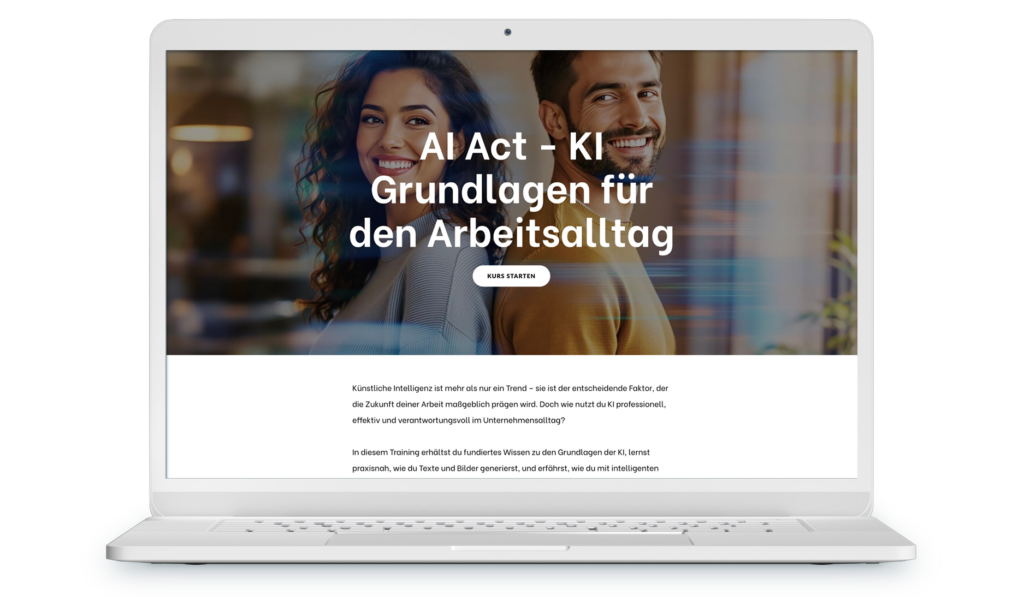
Sie möchten KI-Kompetenz in Ihrer Organisation systematisch aufbauen? Unser KI-Grundlagen-Kurs vermittelt Mitarbeitenden das notwendige Basiswissen für den sicheren und verantwortungsvollen Umgang mit Künstlicher Intelligenz.
Sie suchen Orientierung im KI-Chaos?
Beyond the Hype: Das KI-Briefing für L&D
Alle zwei Wochen in Ihrer Inbox: Unser Newsletter mit relevanten KI-Entwicklungen, Tool-Checks und sofort anwendbare Mini-Hacks – gefiltert für Ihr L&D.