Tight budget, high expectations (part 2):
What does a good L&D strategy look like?
17-04-24 | 5 minutes reading time
What does a good L&D strategy look like?
17-04-24 | 5 minutes reading time

Julia Kammermeier
Customer success
In first part of our blog series we have already emphasized how important L&D is for the success of a company and that a team that continuously develops and adapts flexibly is not only an advantage, but essential. A well thought out L&D strategy can help foster such a team. But how can this be achieved within a limited time and budget? In the second article in our series, we will show you step by step how to develop a pragmatic, cost-effective and contemporary L&D strategy that not only aligns with your business goals, but also inspires your employees.
To ensure the success of your L&D strategy, it is crucial to involve a wide range of key stakeholders in the process from the outset. In addition to management, who not only approve budgets but also set the strategic course, and executives, who have deep insights into the learning needs of their team and can motivate active participation, employees also play a central role, as they are the target group of L&D initiatives and benefit directly from the measures.
In addition, it is essential to involve the works council in the development of the L&D strategy. The works council represents the interests of the workforce and can provide valuable perspectives on working conditions and employee satisfaction. Early consultation with the works council can help to dispel concerns or resistance and achieve broader acceptance for the planned measures.
Not to be forgotten is the IT department, which plays a key role in the implementation of e-learning tools and platforms. Integrating new technologies into the existing IT ecosystem can present challenges that are almost impossible to overcome without the expertise and support of IT experts. They can also provide valuable insights into the scalability, security and sustainability of L&D technologies.
By integrating these different groups into the creation process - from discussions and surveys to application testing - you ensure that the strategy is fully aligned and the needs of all stakeholders are taken into account. Demonstrate the specific benefits to each stakeholder: the return on investment (ROI) of L&D for management, the positive impact on team performance for managers, the professional development opportunities for employees and the importance of transparent and equitable implementation for the works council. The involvement of IT also ensures that the technical implementation runs smoothly. The broad acceptance and support of your L&D strategy by all these stakeholders will contribute significantly to its long-term success.
The first step in developing an L&D strategy is to understand your corporate goals. What are the overarching, strategic goals that your company wants to achieve? Do you want to increase productivity? Drive innovation? Improve customer satisfaction? Once you have identified these goals, you should consider what skills and competencies your employees need to drive these goals and how they will get there.
Next, you should think about your budget. How much can you realistically spend on L&D initiatives without overstretching your financial resources? Are there areas where you can optimize costs - for example, by creating learning content in-house rather than buying in external content? By understanding your budget constraints, you can develop an L&D strategy that maximizes impact without breaking the bank.
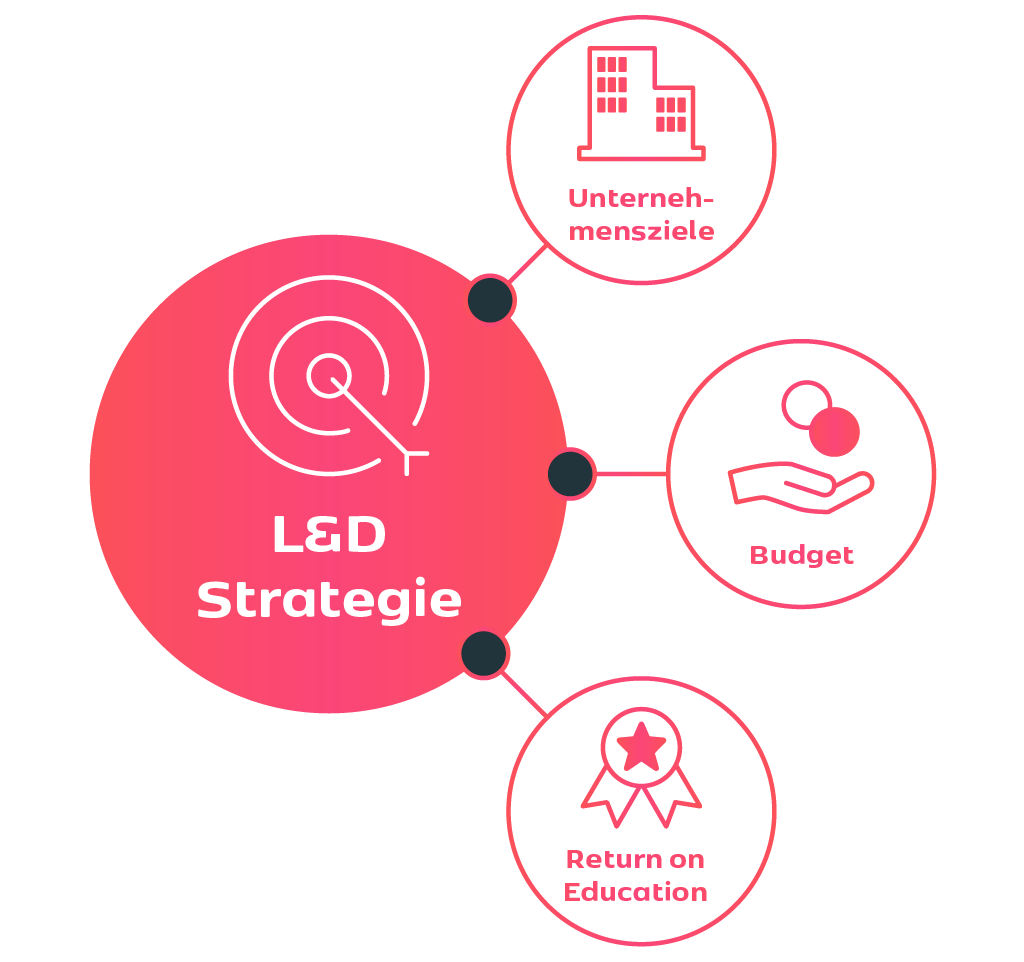
It is essential to focus on the "Return on Education" (RoE) - i.e. the ratio of investments in training measures to the benefits they bring. However, current practices for measuring the success of training are inadequate. According to the study L&D Monitor 2024 by Studytube, 22.4% of companies do not measure the success of training at all. For small companies, the figure is as high as 40.3%. If success is measured, then in 3/4 of cases it is in the form of employee feedback, which is often rather positive. Although this feedback is nice, it often has little to do with the actual success of the training. This is because these key figures can only say something about the attractiveness of the learning offer, but little about whether knowledge has been retained and what has been learned has been applied and is therefore effective. Transfer success and, above all, business success are the better levels for evaluating RoE. Companies should therefore implement measures that make a significant contribution to this.
This is about understanding the gap between the skills your employees currently have and the skills they need to do their jobs effectively. Use tools such as surveys, performance appraisals, direct employee feedback and AI-powered tools to identify these gaps.
Another critical factor is time. Consider how much learning time is realistic. Keep in mind that learning time is also working time. Employees should not have to work overtime or use their free time for this. E-learning or asynchronous training courses are very well suited to giving employees flexible time allocation for learning, depending on their own workload.
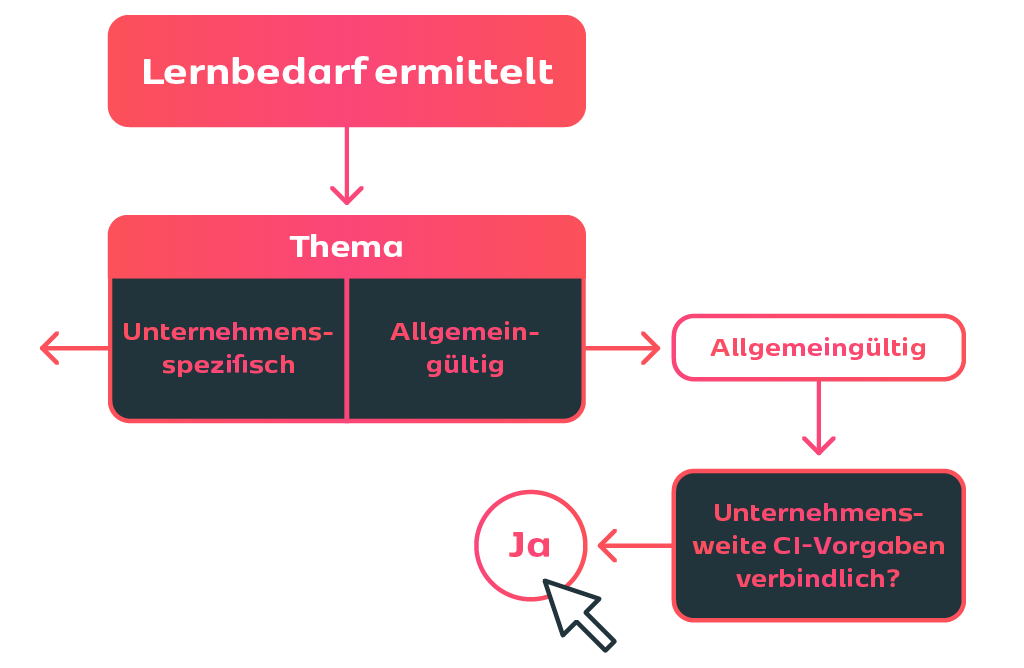
Selecting the appropriate learning formats is a critical step in designing effective L&D strategies. At the beginning of every e-learning content project, there is a central question: Where does the content come from? The development of a content strategy aims to answer this question and make a decision between producing learning content in-house and acquiring external resources. It is important to define the procurement and production processes, select suitable tools and decide when to choose which of the three main options: In-house production, purchase of standard content or purchase of customized content from external service providers.
Deciding on the right approach depends on various factors. These include the fit of standard content with the corporate culture, the available internal resources, skills and capacities, the time and budget pressure on the project and the availability of suitable content on the market. Our decision tree addresses these and other important questions and supports you in making an informed make or buy decision.
For in-house production, it is crucial to have clearly defined processes and the right tools for content creation. A competent project team with sufficient time resources is just as important as providing simple tools for subject matter experts to enable user-generated content and thus ensure efficient and sustainable e-learning content production.
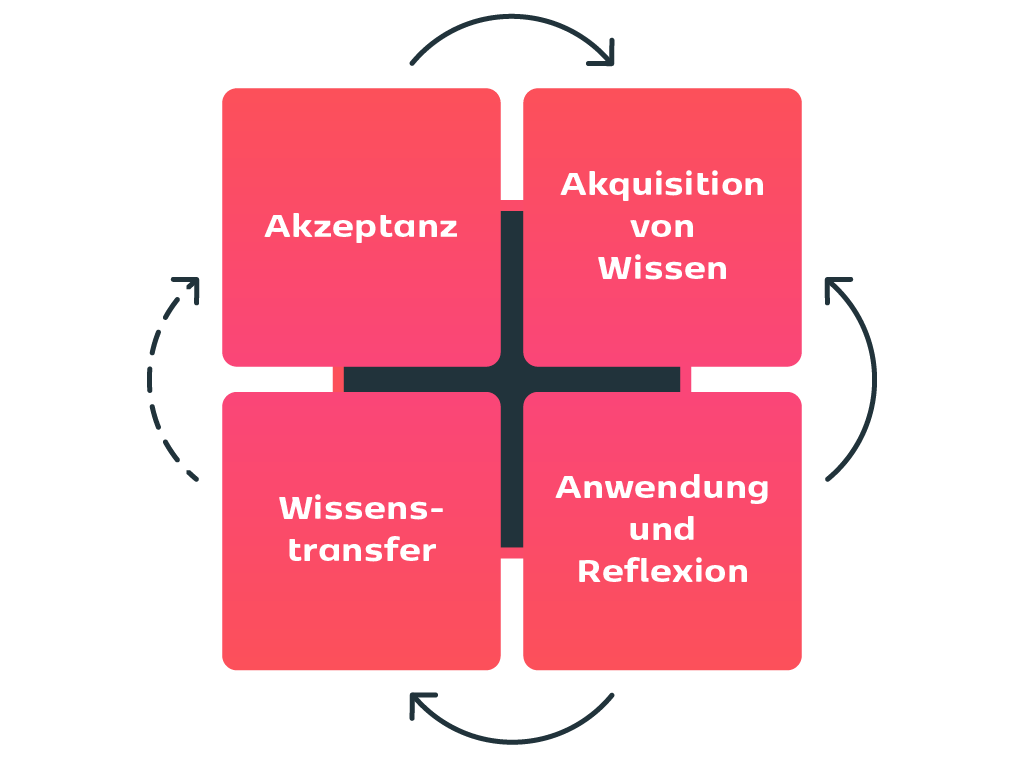
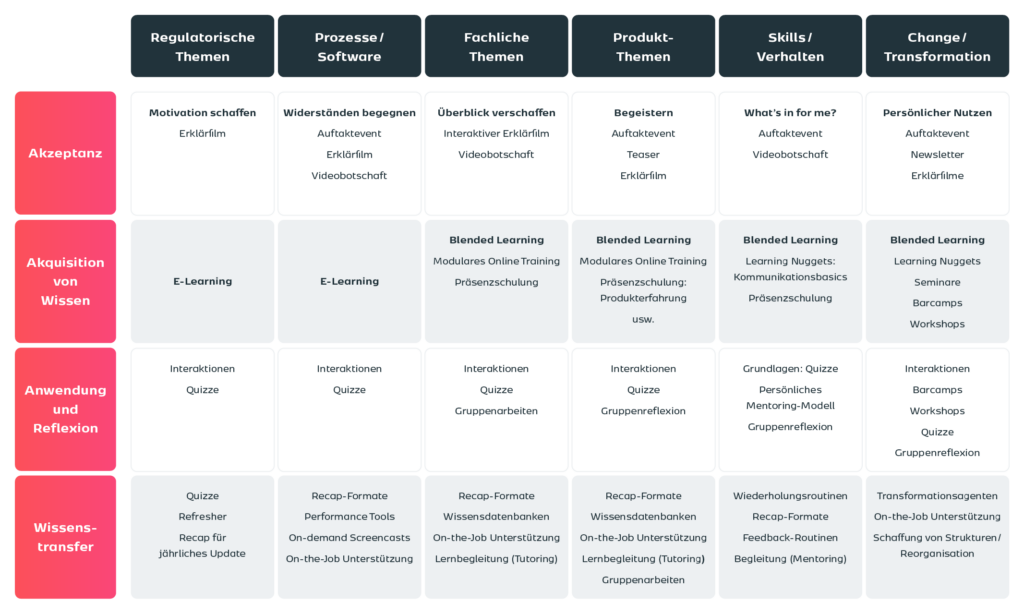
The second important building block is the didactic concept. A didactically sensible selection of learning formats is essential for long-term learning success. Our learning format fact sheets provide a comparison of the various formats, including their advantages and disadvantages as well as their purposes, and support you in selecting the appropriate formats. The model of knowledge acquisition, which ranges from acceptance creation to knowledge acquisition and application to knowledge transfer, can help to align the learning formats according to the different phases of the learning process.
These considerations form the basis for a topic module matrix, which serves as a scheme for identifying and selecting didactically meaningful learning formats. For a more in-depth look at didactic concepts and how learning content can be transformed into effective training, you can find further information in our Blog post on e-learning didactics.
Creating a corporate culture that values learning is about more than just providing training. It's about creating a work environment where continuous learning is seen as an integral part of work and not something that needs to be squeezed into free time. As mentioned above, this can be facilitated by offering flexible learning opportunities that can be integrated into the normal working day. For example, short Web-based trainings (WBTs) or Microlearnings, which can be accessed at any time during the working day and also on the go. This not only ensures continuous learning, but also conveys the message that learning and working are not separate entities, but are both important parts of an employee's working life.
It is important that you regularly review your L&D strategy. However, it is also important to do this in a way that does not take up too much time and resources. Instead of extensive evaluations after each course, consider regular short feedback sessions or online surveys. Continuous feedback allows you to identify and address issues early on, making your L&D strategy more effective without too much effort.
A sophisticated L&D strategy is a decisive factor for the long-term success of a company, especially when resources are limited. It is about investing wisely and designing learning processes in a way that both supports the company's goals and motivates and develops employees. The challenge lies in establishing a learning culture that is seamlessly integrated into everyday working life and at the same time masters the balancing act between cost efficiency and effectiveness. The involvement of all stakeholders and the continuous review of measures are not a luxury, but a necessity in order to keep the L&D strategy alive and relevant. The key to success lies in the skillful balance between the needs of the employees and the goals of the company - and in the willingness to constantly adapt and improve.
Overall, an L&D strategy should focus on quality rather than quantity. Concentrate on a few, but the right measures - and align your L&D strategy primarily with the company's goals.
In the third and final part of this blog series, we take a closer look at a topic that can alleviate, if not solve, the challenge of "lack of resources in L&D": User-generated content in general and creating learning content with AI support in particular.

Julia Kammermeier

Maximilian Winnen
Business Development Manager
Discover the ideal e-learning solution for you! Simply contact us via the contact form, by e-mail or call us directly. Let's get started together!