Adaptive learning -
Potential and practical hurdles
08-05-25 | 4 minutes reading time
Potential and practical hurdles
08-05-25 | 4 minutes reading time

Friedl Wynants
Founder & Managing Director
Adaptive learning automatically adapts learning content to individual needs. According to the study mmb Trendmonitor 2024/2025, 71% of education experts rank it as a top learning technology, but data protection and high operating costs make implementation difficult. The solution: With pragmatic approaches such as the “Fast Track” method, organizations can start immediately and save valuable work hours annually.
For the 19th time, the mmb Trendmonitor provides insights into the future of digital learning. In the current 2024/2025 edition, 71 education experts from German-speaking countries were surveyed. The study clearly shows: Artificial intelligence will significantly shape the development of learning technologies. According to the respondents, generative AI is rapidly gaining strategic relevance.
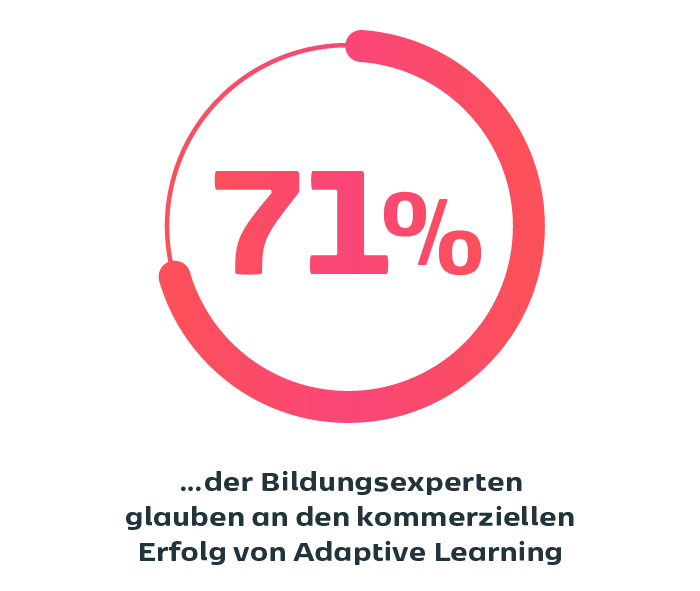
A small surprise for me is the ranking of the most economically promising learning applications. For the first time, "adaptive learning " is at the top with 71 percent approval (previous year: 56 percent), closely followed by "chatbots/learning assistants" with 66 percent. The experts are therefore unanimous: AI-supported, personalized learning will dominate the future
It may sound quibbling, but in my opinion, adaptive learning is not a form of learning that makes sense alongside video tutorials, learning nuggets or chatbots, as presented in the study. Rather, it is a basic orientation, almost a mindset
Why do I think it makes little sense to classify them alongside specific tools? Quite simply, a chatbot, for example, is already adaptive. After all, it should be able to respond to the learner's prior knowledge, interests and personal preferences. Adaptive learning can be implemented in the same way with learning formats such as "learning nuggets", which are also mentioned in the study as an alternative form of learning. And this is where the "problem" begins for me: by adaptive learning, everyone understands something different, mostly their personal ideal of learning.
Let's venture a definition: In my view, "adaptive learning" means that the learning offer reacts to personal, individual characteristics of the learner or adapts automatically on the basis of such characteristics.
The basic idea that, thanks to AI, each and every learner can have an individualized learning path is of course great. However, the implementation has technical catches: On the one hand, it needs data, data, data - because adaptive learning can only work on the basis of a large amount of personal data on the learner. Secondly, it requires specialized platforms that can implement adaptivity. This is precisely where the practical challenges lie.
The desire for adaptive learning solutions is understandable, but companies will implement them at different speeds. Larger companies with the appropriate budget and internal resources will be able to implement this change more quickly.
Data protection barriers: Works council says ‘no’
A key challenge for all companies will be data protection - especially when it comes to collecting data on the scale required for adaptive learning. Even today, discussions with the works council are the order of the day if comparatively little data is to be collected as part of a WBT, or even if a little more data is generated when using the xAPI format: However, we are still a long way from highly individualized learner profiles.
Technical barriers: Amount of data needed and specialized platforms
For small and medium-sized companies, in addition to the minimum amount of data required for adaptive learning, the necessity of specialized systems will be a major hurdle. In addition, clearly defined skill profiles are required in order to introduce adaptive learning in a meaningful way - and these cannot be created "just like that".
Despite all the advantages that adaptive learning will bring: I currently consider it a buzzword, which - certainly not without good reason! - is seen as a major innovation in corporate learning, but one that is (still) not very well defined.
It is important to me to honestly raise awareness of the challenges in this context, but at the same time to think pragmatically about how we can get the horsepower on the road, because the potential is undisputed.
You can start small with adaptivity. An example from our practice: The fast-track method for mandatory training Before a training course or before each chapter, there is a small, well-designed query on certain aspects. This then decides whether the learner really needs to go through the whole content again or whether he/she can skip the chapter or parts of it.

What are the benefits? Firstly, it promotes acceptance among learners because they don't have to repeat everything according to the "one size fits all" principle, regardless of their level. And secondly, depending on the size of the company, it saves thousands of working hours, especially in the case of company-wide mandatory training courses
Use case: 20,000 working hours saved thanks to Fast-Track
One of our customers, a German car manufacturer, has calculated that it can save up to 20,000 working hours a year using our fast-track method alone. This example is intended to show that we can also understand adaptive learning as a mindset that leads to creative solutions for learning professionals.
The future undoubtedly belongs to adaptive learning - I agree with the experts interviewed. However, I see the path to it as a gradual evolution rather than a sudden revolution. While - as is so often the case with technological innovations in corporate learning - large companies will take on a pioneering role, smaller organizations with pragmatic approaches can already benefit from adaptive elements today.
For me, the key is not to view adaptive learning as a single tool or format, but as a basic concept that can be implemented in different ways. In this way, the shift towards personalized learning will be possible for all company sizes - albeit not immediately and not at the same pace.
You can download the mmb Trend Monitor 2024/205 (in German) here.

Friedl Wynants
You have the goals, we have the solutions – together we will find the best one for you.