Future Skills:
6 tips that you can implement today
16-03-23 | 5 minutes reading time
6 tips that you can implement today
16-03-23 | 5 minutes reading time

Annalena Moritz
Consulting
It was no coincidence that we chose the topic "Future Skills" for our second e-learning expert talk. Since mid-2022, we have seen how AI technologies such as ChatGPT, DALL-E, Midjourney and many more have been developing at an unprecedented speed. As a corporate learning provider and employer, we are also asking ourselves the question: how can we prepare today for the changes of tomorrow? Because the fact is: the world of work will change drastically and even previously "safe" areas of work can and will be taken over by AI. Those who do not adapt or are too slow will be left behind. So what can you as a company do NOW and what role does L&D play in this change process? We have 6 tips for you that you can implement today to survive in the working world of tomorrow.
The ability to learn is the meta-competence of the future - both for individual employees and for the organization as a whole. Only those who can (and want to) learn can acquire future skills. For companies, this means that they must create the conditions for employees to acquire future skills in the first place. A distinction must be made between two levels:
Individual level: For many, the topic of future skills is not yet really tangible and too abstract - an awareness and willingness must first be created here. The individual employee must be aware that future skills are an issue at all and that he or she must learn new things in order to prepare for the changing (working) world.
Company level: As a company, you need to ask yourself how you can enable your employees to acquire future skills. This includes a learning culture and the corresponding framework conditions. In concrete terms, this means making learning time and budget available and adapting processes to the new requirements. Work and further training must be more closely interlinked so that employees can gain further qualifications.

Friedl Wynants
Founder and Managing Director
youknow GmbH

„Future skills are a dynamic set of competencies, i.e. the main thing is to be adaptable. The individual needs the ability to learn, the company can provide the learning opportunities.“
And last but not least, it is important to make e-learning palatable to the target groups. Only with good acceptance management will it be possible to inspire learners and ultimately achieve the goals of the educational project. Acceptance management depends on three key points: The organization, the communication and the learning content itself.

Dr. Matthias Görtz
Head of Learning Design & Qualification Transformation
Porsche AG
„New product strategies, new framework conditions and new technologies are fundamentally changing the workplace for everyone. On the one hand, this is an opportunity to experience and help shape change with a great deal of curiosity and openness. On the other hand, it is a challenge to accommodate this in everyday working life. It is important that employees experience this process of change and these constantly new requirements as something where they receive support. Where they are taken by the hand, but also given the freedom to try things out.“
Many companies are now asking themselves: Should I invest a lot of time, money and effort today in measures that may turn out to be irrelevant? Or should I wait and see what will be relevant in a few years' time? In uncertain times like these, with scarce resources in every respect, nobody wants to waste resources unnecessarily. Nevertheless, we recommend: Don't wait and see. Change processes are not a sprint, but a marathon - which requires a lot of preparation, a lot of lead time and, above all, a lot of stamina. So how can you strengthen your employees' motivation to change so that the change process is a success? Here is a practical formula to help you define your change process: The N-A-R formula. This formula will help you to strengthen your employees' motivation for change and personal responsibility.
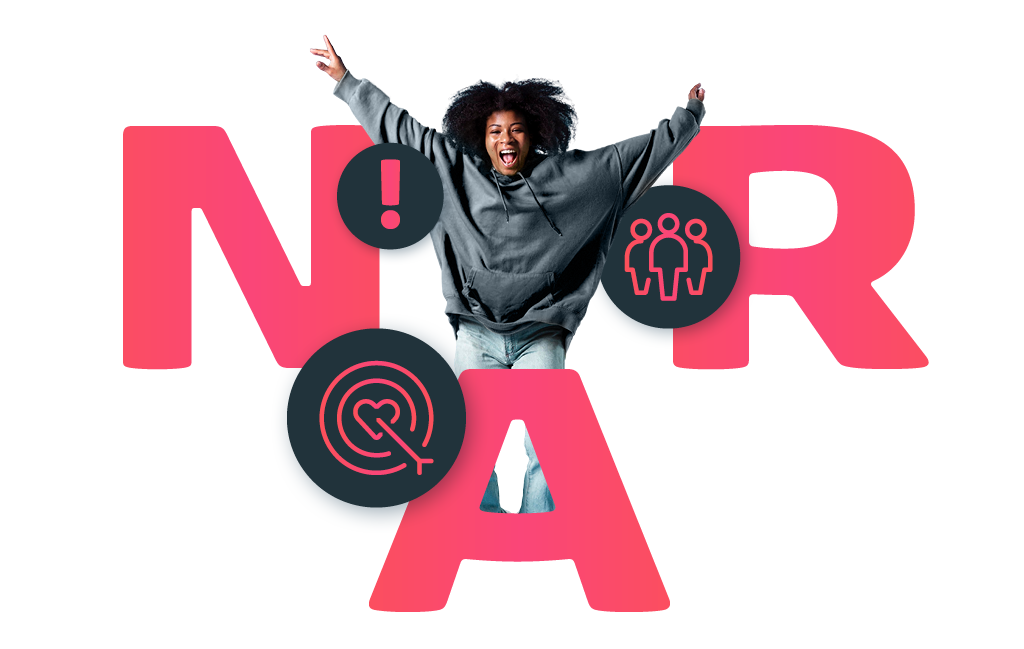
Employees must realize that there is a need to change - and that they can expect personal costs if they do nothing. One example of necessity when it comes to AI is: "It's not an AI that will replace you, but a person who uses the AI! So be that person yourself." It is important that they do not use threats as leverage, but instead focus on necessity.
Even or especially during a change process, you should provide your employees with incentives that make them want to change. It's not about "rewarding" them for a certain behavior, but about increasing their intrinsic motivation. An example from our own experience: Our concept developers sometimes receive hundreds of PDF pages from customers, from which concise training courses are to be created. Here we have illustrated how AI can summarize these documents in just a few minutes and often save you a lot of tedious detail work. This is just one of many use cases that can make your day-to-day work easier.
A change process cannot be successful without communication and role models. You need resources that strengthen the self-efficacy of the measures, e.g. people with expertise in the field of AI that employees can turn to. At youknow, for example, we have a person responsible for AI innovation who moderates this change process. He or she provides the team with technical support, highlights positive examples and practical use cases, but also points out the limits and dangers and offers regular Q&A sessions in which anyone at youknow can ask their questions. In addition to human resources, tools, learning content and training opportunities are also important for supporting and implementing the change process.

Franziska Stadelmann
Business Consultant OCM
Plat4mation
„I can very well imagine that virtual reality also helps to prepare for general change processes. VR simulates what could happen, but I have a safety net because it's not the real world - and I can practise risk-free. “
Employees are no longer just learners, but knowledge carriers Due to the rapid changes and the associated strong growth in demand for learning content, so-called "user-generated content" is becoming increasingly relevant - because L&D will not be able to meet the demand alone. As a company, you must therefore also create opportunities for employees to share their knowledge with colleagues. This can be done, for example, with the help of tools such as knowtion, which enable people with no previous didactic knowledge to create learning content in no time at all. This provides employees with more learning content that can be shared quickly and easily within the company.
By establishing a culture of knowledge sharing, you can increase personal responsibility and learning competence Collaborative learning and the sharing of one's own knowledge enables employees to consolidate their existing knowledge, but also to acquire new knowledge. Every person has a large repertoire of specialist knowledge, but this only becomes sustainable through application and active sharing. You also create sensitivity to learning as something that is taken for granted, which is omnipresent and does not have to be strenuous.

Stefan Deibel
Head of People Development & SPIE Academy
SPIE Germany & Central Europe GmbH
„We have created new learning spaces in which our participants/employees can come into contact with the new technologies live and in color. We want to create completely new framework conditions that enable us to combine practice with theory and, at the same time, further promote the approach of peer coaching and learning together and from each other.“
When people talk about future skills, the focus is often on digital skills. However, it is precisely the soft skills, i.e. the interpersonal skills, that can never be replaced by technology, such as leadership, collaboration, empathy, team skills, critical thinking and many more. These are all skills that cannot be taught by the company alone. What you can do as a company, however, is to create the framework conditions for employees to acquire these skills. In concrete terms, this means provide learning budgets, schedule learning time during working hours and restructure processes, so that there is enough time for training and development.

Peter Spiegel
Futurologist & CEO
WeQ Institute gGmbH
„Mindfulness, team competence, multi-perspectivity, systemic thinking and much more - these are skills that you need not only to deal with digital possibilities in today's world, but also to deal with them in such a way that you can think and contribute to the general development of innovation.“
In the future, L&D must move away from the self-image of "we create the training" and should instead see themselves as "enablers" who pass on knowledge to the subject matter experts and enable them to create content themselves. This - in combination with smart tools that bring L&D knowledge to the experts - is the much faster and more scalable way to meet the increasing demand for learning content.
Managers must also redefine their understanding of leadership. They are now role models and "growth coaches " who support their employees in discovering skills that they may not even have known they possessed - but which are relevant for the future (keyword: upskilling).
Dr. Matthias Görtz
Head of Learning Design & Qualification Transformation
Porsche AG
„Are we still called L&D or should we be talking about "performance and culture" rather than "learning and development"?“
In the working world of tomorrow, the skills and competencies you bring to the table will be more important than ever. With the right future skills, companies will be able to prepare for the challenges of the future and be successful. We hope that our 6 tips will help you to acquire and develop these skills.
You have the goals, we have the solutions – together we will find the best one for you.