Digital natives vs. digital immigrants:
How to inspire everyone
04-07-22 | 11 minutes reading time
How to inspire everyone
04-07-22 | 11 minutes reading time

Julia Kammermeier
Customer success
Digital natives (born after 1980) prefer flexible, interactive, and fast learning with tangible benefits. Digital immigrants (born before 1980) want structured, step-by-step guidance with personal support. Successful e-learning concepts offer a solution for each group: beginner and advanced paths, responsive design, and optional in-depth courses.
Metaverse, artificial intelligence, virtual reality - modern technologies are developing faster and faster. Even younger generations such as millennials or Gen Z, who have grown up with digital media, are sometimes overwhelmed. For those who have not grown up with it, the hurdle is even higher.
Companies face a particular challenge in the area of corporate learning - now that part of Generation Z has arrived in the workforce: How can they bridge the gap between generations that have very different learning behaviors?
The terms "digital natives" and "digital immigrants " were coined by US educator and manager Marc Prensky. Translated, the two terms mean something like "digital natives" and "digital immigrants". In other words, those who have grown up with digital media and those who only get to know them later in life. Of course, there are different levels of digital competence in both groups. There are digital natives who know little about new media and there are digital immigrants who are absolute technology professionals. The learning behaviors described below therefore affect a large proportion of the group members - but not all of them. So how exactly do these two groups differ?
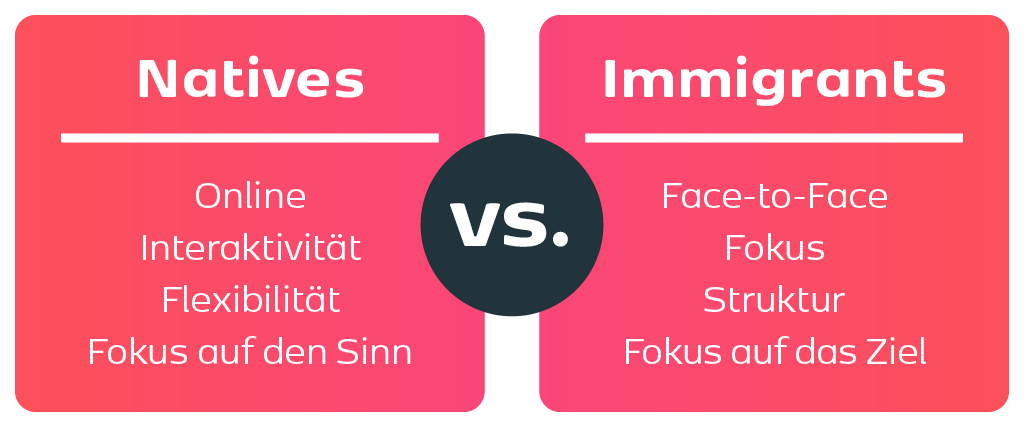
Digital natives are people born from around 1980 onwards. They are the first generation to grow up with new media such as the internet and cell phones. They feel comfortable in the online world - whether in their private or professional lives. There are a number of features that characterize the learning behaviour of digital natives:
They ...
... are value-oriented: A very important point for digital natives is the "purpose": "Why should I do this? What sustainable added value does it provide me - and the world?" These are questions that younger generations ask themselves with every task.
... are always online: Thanks to smartphones, everyone is always connected to the internet. The internet is the first port of call. Learners want to be able to access content from anywhere and at any time.
... prefer online communication: The younger generation prefers to communicate online. Much of their social contact takes place online - e.g. via messenger and social media.
... use words and emojis differently: "Sus", "IYKYK" or "main character energy" - the younger generation uses a completely different language. Emojis also have a completely different meaning. Do you still use this emoji 😂 to express laughter? Congratulations, you can officially call yourself "old". Gen Z now uses 💀.
... want flexibility in learning: Only when you've finished step 1 can you start step 2? Younger learners prefer to learn at their own pace and want the flexibility to complete training as and when they feel like it.
... like it fast and entertaining: 5 pages of introduction and 20 clicks until you get to the actual task and no video in sight? Young people like it fast and it should be fun. They prefer entertaining content such as infographics or videos that have to do one thing above all: convey knowledge quickly.
... prefer interactivity: Instead of frontal teaching, digital natives prefer an immersive experience - in other words, they want to be able to immerse themselves completely in the learning environment. They want to interact with the content and acquire knowledge themselves.
Digital immigrants are anyone born before 1980 who did not grow up with the internet, smartphones and other digital technologies. They have had to learn new technologies and a new "language" - some faster than others. As they have had to learn these new skills in adulthood and have not grown up with them like younger generations, the learning curve is somewhat flatter for them. This also means that they learn very differently to digital natives:
They ...
... are goal-oriented and structured: Digital immigrants prefer structure and objectives. They prefer training courses that are structured in such a way that they guide learners step-by-step through the lessons. They are focused on successfully completing the training.
... prefer "real" language: Digital natives prefer full sentences and spelled out words rather than acronyms.
... need time to familiarize themselves with the technology: Digital immigrants need a settling-in period to familiarize themselves with the training.
... like to focus on one thing: Instead of being distracted by many different things on the screen, they prefer a clear text-image structure. This allows them to concentrate fully on the content.
... prefer a fixed contact person: While digital natives look for answers to questions directly on the internet, digital immigrants prefer a fixed contact person. This contact person should be available for questions and problems and guide the learners through the training.
... need less personalization: Digital immigrants prefer training without a lot of frills and personalization options - they want to focus on the essentials.
A new generation is already here: AI Natives – people who are growing up with ChatGPT, AI assistants and adaptive systems or have seamlessly integrated them into their everyday learning and working lives. This group, mainly from the youngest Generation Z and upcoming Generation Alpha, differs fundamentally from digital natives in their expectation of conversational and personalized learning formats. While digital natives want flexible and interactive learning, AI natives expect learning on demand through AI-supported systems that answer their specific questions immediately. They are used to technology adapting to them – not the other way around. This poses a further challenge for corporate learning: in addition to digital immigrants with structured learning paths and digital natives with flexible formats, AI natives need adaptive, conversational learning systems. The most successful e-learning strategies of the future will serve all three generations and create a multi-generational ecosystem in which different learning preferences exist in parallel and enrich each other.
Digital natives and digital immigrants have very different learning behaviors and requirements for E-learning training. So how can you reconcile these differences and inspire learners of every generation? Here are a few simple tips:
Beginner and advanced mode: If possible, create a switch at the very beginning of the training to divide your learners into beginners (=digital immigrants) and advanced learners (=digital natives). Of course, this is not about technical expertise, but about how well the learners know how to use learning tools. This allows you to adapt the following content to the respective target group. For digital natives, for example, you can include interactive and customizable elements. For digital immigrants, you can reduce interaction to a minimum and guide learners through the training in a structured way.
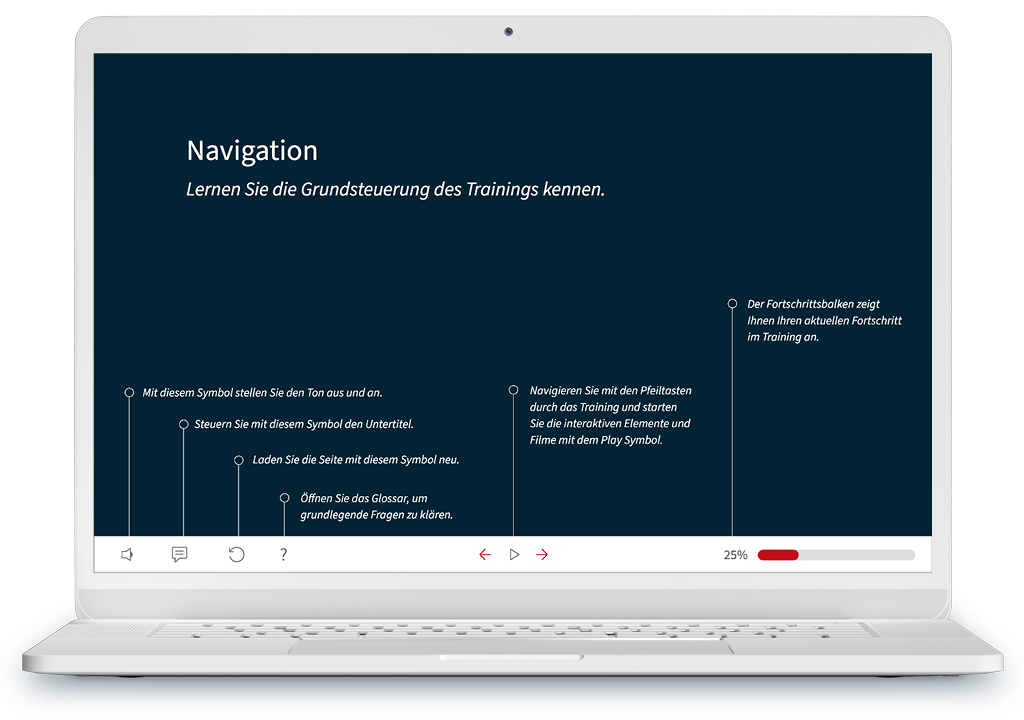
Optional pre-training: Digital immigrants often need some time to familiarize themselves with new tools. It is also not always immediately clear to every native how something works. An introductory slide with clear instructions and a short "How to navigate through the training" guide allows learners to familiarize themselves with the training more quickly. Digital natives can skip the training - as they like to do with video game tutorials.
Create flexibility: Digital immigrants need structure, digital natives need freedom. To meet both requirements, you should structure training courses in such a way that they have a clear learning path (e.g. steps 1-5), but still give learners the option of completing the steps out of chronological order and jumping between different lessons. You can also put together ready-made "training bundles" or allow learners to put together their own personal "bundle" - according to their needs, goals and learning level.
Give learners freedom: Always give them time freedom. There are often quizzes where you only have a few seconds to answer. For digital immigrants who still have to familiarize themselves with the technology, it increases the pressure immensely if they also have to answer questions within a certain time. This leads to a negative learning experience and is not effective. The aim should be for learners to really be able to absorb what they have learned in the long term and apply it in practice, not to be able to answer a question within 10 seconds.
Communicating goals and values: While digital immigrants need a clear learning goal, you also need to communicate the added value of the training to digital natives. So you need to answer two questions: "What is the goal of the training and why should I achieve the goal?" Instead of simply giving instructions, you should communicate to the learners what added value the training has for them personally. Emphasize what skills the learners will learn thanks to the training and what positive impact it will have on them and the world.
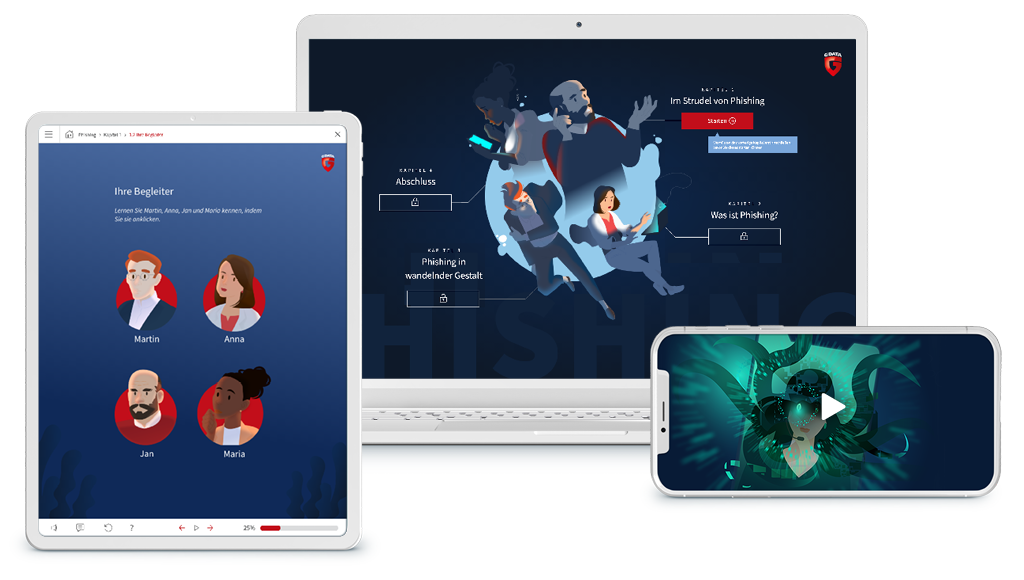
Responsive design: To ensure that all learners can learn on their preferred device, you should always offer training in a responsive design. Responsive means that the content adapts to the screen and the display is optimized so that the content always looks good - on a laptop, smartphone or tablet. This way, digital immigrants can relax and learn from home on their desktop computer, while digital natives can complete the training on their cell phone while on the move.
As much information as necessary, as little as possible: Digital natives want to read as little as possible (keyword "TLDR" = "Too long, didn't read"), while digital natives need more detailed information. Provide additional information, e.g. in a pop-up or drop-down. It is important that you clearly indicate how learners can access this additional information. A simple hyperlink with the text "Click here for more information" is often sufficient.
Short and concise videos: In addition to text and images, you should also include videos in your training courses. Both digital natives and immigrants appreciate this medium. But keep the videos short. Instead of one 10-minute video, split the video into several 30-60 second videos. Since digital immigrants prefer "face-to-face" interactions, you can also work with the video format. In such videos, "real" people guide you through the video.
It is important to emphasize that no group is superior to another. Digital natives are not better than digital immigrants and vice versa. Both groups can learn from each other: Digital immigrants can learn technical know-how, but also new creative ways of thinking from digital natives. Digital natives can learn important lessons from the digital immigrants' wealth of experience - after all, the immigrants developed the technologies that the natives are now using.
The boundary between digital natives and digital immigrants does not just run along age lines either Of course, there are also digital immigrants who are very tech-savvy. Conversely, there are digital natives who are more skeptical about modern technologies. Factors other than age, such as social and cultural aspects or access to new technologies, also play an important role in the assessment of digital literacy.
If you want to inspire digital natives and digital immigrants with your E-learning content, you should focus more on the similarities than the differences. Ultimately, there is always a common goal: to acquire new knowledge and skills!

Julia Kammermeier

Andreas Schatz
Key Account Manager
Discover the ideal e-learning solution for you! Simply contact us via the contact form, by e-mail or call us directly. Let's get started together!