AI Disclosure in E-Learning:
The 5-Step Approach for L&D
09-07-26 | 4 minutes reading time
The 5-Step Approach for L&D
09-07-26 | 4 minutes reading time

Dr. Kim Füllenbach
Project lead
What does the EU AI Act mean for your e-learning courses? Will AI-generated content need to be labeled in the future? And if so, when exactly? The short answer is: Not every use of AI automatically requires labeling. The key factor is how AI is used in the specific learning offering. In this article, we’ll show you how to categorize typical L&D scenarios using a simple 5-step approach and develop a practical standard for your company based on that.
In this article, you’ll learn:
There’s a lot of discussion surrounding the EU AI Act about AI labeling. Two main misconceptions have arisen: Some believe that everything created in any way using AI must be labeled. Others assume that the issue primarily affects providers of AI tools—neither of these assumptions is correct.
Important note: The following is not legal advice, but rather our expert assessment for L&D practice. The EU AI Act establishes a legal framework for transparency in the use of AI. However, organizations can determine for themselves, within certain limits, how this transparency is actually implemented in their day-to-day work.
Three questions are enough for an initial quick check:
If you answer “yes” to any of these questions, it’s worth taking a closer look. This raises the question of how you can label the use of AI in your learning program in a way that is both transparent and practical. That’s exactly why we’ve developed a simple 5-step framework.
The AI Act sets the direction but doesn’t answer every practical question that arises in day-to-day L&D work. For L&D teams, one question stands out above all others: When must the use of AI in a learning program be disclosed— and how can this be implemented simply and consistently in everyday practice?
This is exactly where a simple decision-making framework for your own L&D team can help. It translates the abstract requirements of the AI Act into a clear standard and helps ensure that comparable use cases are treated comparably.
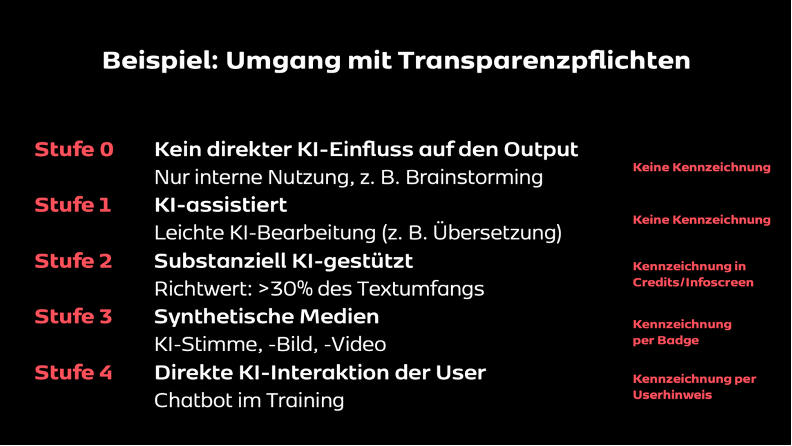
The 5-step framework is not a legal standard, but rather a pragmatic interpretation of transparency requirements for day-to-day L&D operations— and in some respects, it is even deliberately stricter than the legal minimum. The goal is not to evaluate every individual case from a legal perspective, but to create a clear standard that provides guidance to L&D teams and enables consistent decisions regarding labeling.
At this level, AI serves exclusively as an internal tool. For example, it assists with brainstorming, generating ideas, or structuring content, but does not directly shape the final learning content. The final output is created by the author themselves.
A typical example is using an AI tool to gather initial topic ideas for a web-based training course or an explainer video. In such cases, we see no need for labeling.
At this level, AI supports the creation or revision of a learning resource without significantly determining its content. For example, the AI handles translations, refines the language, or rephrases individual text passages. However, the subject matter, structure, and responsibility remain with humans.
A typical example is the linguistic revision of a WBT or the translation of an existing training program into another language. Even in these cases, we see no need for labeling.
At this level, AI shapes significant portions of the final learning content. It no longer merely assists with individual phrasing or translations, but creates larger sections of content independently. While subject-matter review and responsibility remain with humans, the influence of AI on the final output is clearly recognizable.
A typical example is a web-based training (WBT) course in which the initial drafts of the text or chapters are predominantly generated by AI and then subject-matter-reviewed by an author. A possible guideline might be that more than approximately 30% of a text was generated directly by AI. However, what matters is not a rigid percentage threshold, but whether the AI significantly shapes the character of the finished learning program.
In such cases, a transparent disclosure of AI use has proven to be a practical solution—for example, in the opening or closing credits or on a separate information screen.
At this level, AI-generated or AI-modified media are used. For example, learners might hear an AI-generated voice, encounter an AI avatar, or see synthetically generated images or videos within a learning program. It is not always immediately apparent to them that this content was artificially generated.
This is precisely why transparent labeling has proven to be a practical standard—for example, through a visible note or a badge directly on the media in question. This makes it clear to learners when AI is being used without unnecessarily interrupting the learning process.
At this level, learners interact directly with an AI system— for example, with a chatbot, a learning buddy, or another AI-powered assistant. Here, the AI is not just part of the learning experience; it becomes an interaction partner in its own right.
In these cases in particular, transparency is especially important. Learners should be able to clearly recognize that they are interacting with AI. A clearly visible notice at the beginning of the interaction or a distinct label for the system creates clarity and builds trust in the learning experience.
When it comes to AI labeling, we keep encountering the same questions in conversations with L&D leaders. The 5-step logic helps to systematically address these uncertainties.
The transparency requirements of the EU AI Act will be a constant presence for many L&D teams in the coming years. In our view, however, the key is not to find the perfect solution for every single case right from the start. What’s more important is to establish a shared basis for decision-making in the first place.
A simple internal framework helps to consistently evaluate the use of AI, make uniform decisions within the L&D team, and transparently show learners when AI is being used. This is exactly what provides guidance—for everyone involved.
Dr. Kim Füllenbach
You have the goals, we have the solutions – together we will find the best one for you.